AI proof of concept: when you need one, how to run it, and what it costs


An AI proof of concept (PoC) is a short test that shows whether an AI model can do one task on your own data well enough to be worth building. At Ronas IT, a proof of concept that checks a model on your data costs $1,000 to $2,000 and takes at least 1 week; one that needs working code starts at $5,000 and takes at least 2 weeks. Run one when the task has no fixed rules and nobody knows if a model can handle it. Skip it when plain code or a database query can make the decision.
This guide is for founders and product owners who are deciding whether to add AI to a product or an internal process. For the architecture and the price of the full build, see our generative AI integration guide.
Does the task need AI, or will regular code do?
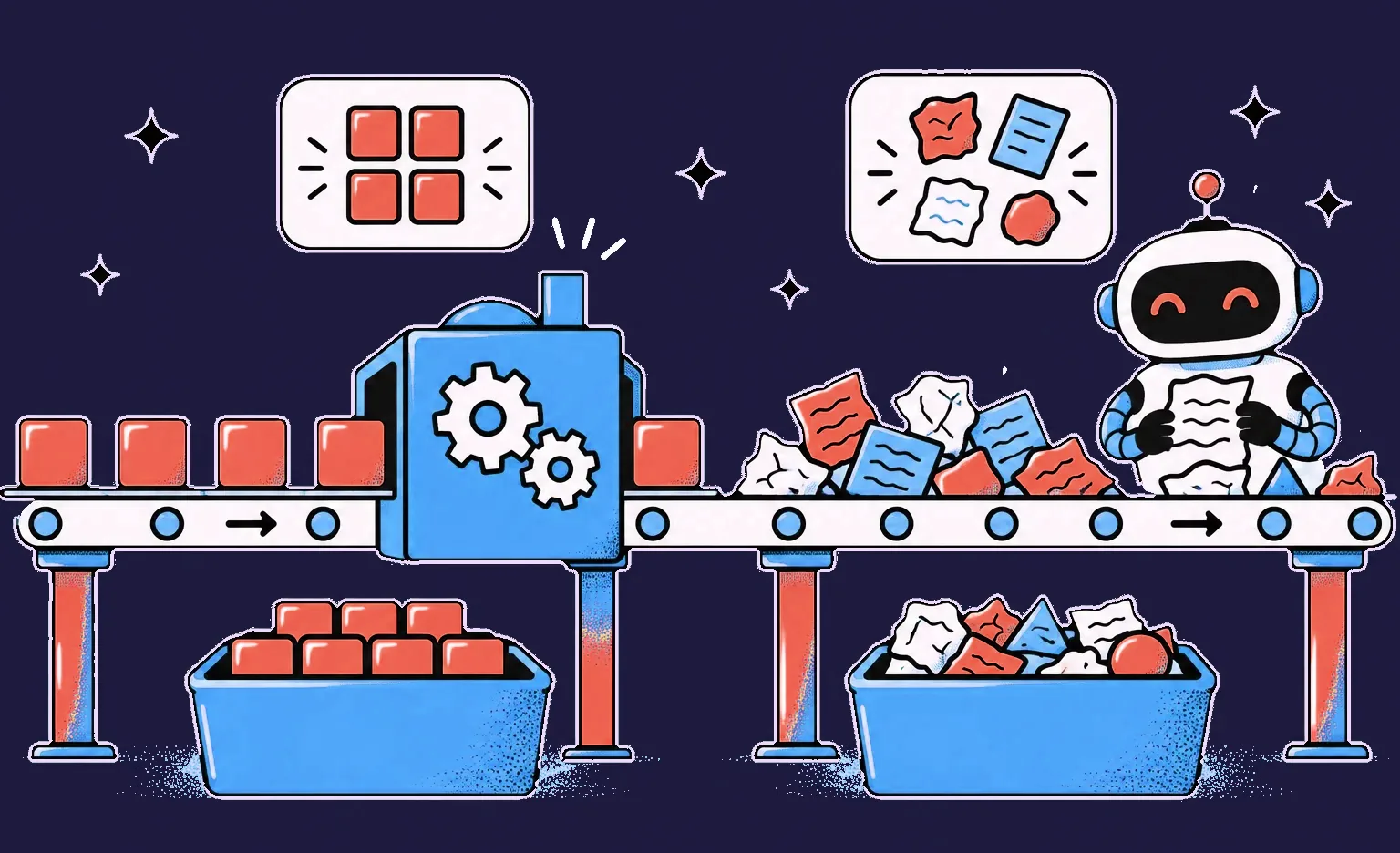
A task needs AI when its input is free-form and the rules for it would be too many to write: emails, documents, photos, calls, or questions in the customer's own words. If the decision can be written as rules, regular code does it more cheaply, gives the same answer every time, and is easier to check. The first rule in Google's Rules of Machine Learning says the same: “Don’t be afraid to launch a product without machine learning.”
Signs that regular code is enough
- The rules fit on a page: tax, payroll, discounts, stock counts, and deadlines follow rules that someone can write down and test.
- The answer has to be exact: a price, a balance, or a policy has one right value, and a close guess is a mistake.
- Someone has to explain each decision: an auditor or a customer may ask why the system did what it did, and a rule gives a clear answer.
- There are no examples to learn from: without past cases with known outcomes, there is nothing to test a model on.
Signs that AI is worth testing
- People read and decide by hand: someone sorts emails, reads contracts, or checks photos every day, and the task repeats.
- The input varies too much for rules: customers describe the same problem in hundreds of ways.
- You have examples with right answers: past emails with the team that handled them, or documents with the fields a person filled in.
- A wrong answer can be caught: a person reviews the result, or a mistake costs little and is easy to undo.
A system can use both. In our own sales process, a database query picks the leads for a follow-up: we sent the last message, the lead has not answered for more than a day, and the manager has not set a status that stops follow-ups. The model's only job is to write the message itself.
Exact facts carry a risk when a model or a chatbot states them. In 2024, a Canadian tribunal ordered Air Canada to pay a passenger damages after its website chatbot said the passenger could apply for a bereavement fare retroactively, after travel, which the airline's policy did not allow. The tribunal held that the airline is responsible for the information on its website, whether it comes from a static page or a chatbot. It is safer to show prices and policy terms from your own system exactly as they are written there.
What a proof of concept is, and what it does not prove
A proof of concept tests one task on your anonymized or synthetic examples and compares the result with a pass mark you agreed on before the work started. It gives you a decision and the facts behind it: build the feature, change the approach and test again, or stop. It is not a product: it has no polished interface, does not run at full load, and does not go to users.
A proof of concept answers these questions:
- Quality: how often the model gets the task right on your examples, and where it fails.
- Approach: whether a ready model with instructions is enough, or the task needs your documents or a custom model.
- Data: whether the data the model needs exists, is good enough, and can reach the model.
- Cost per task: what one answer costs in model usage, the model part of the full feature's running cost; retrieval, hosting, and monitoring add to it.
It does not prove that users want the feature, that the system holds up under real traffic, or that the full build will cost what the test did. Those questions belong to the next stages.
AI proof of concept vs prototype vs MVP vs pilot
The four terms answer different questions. A proof of concept checks whether the AI part can work. A prototype shows how people will use it. An MVP (minimum viable product) checks whether users want it, and a pilot checks whether it works in real operations at a small scale.
| Stage | Question it answers | Who uses it | Result |
|---|---|---|---|
| Proof of concept | Can a model do this task on our data well enough? | Your team and the developers | Test results and a decision to build, change, or stop |
| Prototype | How will people use the feature? | Test users and designers | Screens or a clickable flow that people try |
| MVP | Do users want the product and keep using it? | The first real users | A working product with the core features |
| Pilot | Does it work in real operations? | One team, region, or group of customers | Results from real use before a full rollout |
Our article on PoC vs prototype vs MVP compares the first three stages for any software product, not only for AI features.
How to choose the task for your first AI proof of concept
Choose a task that people already do by hand, that repeats often, and that has past examples with known right answers. The task should have one number that shows success, such as the share of emails sorted to the right team. A wrong answer should be easy to catch, so a person can review the output in the first version.

Leave these tasks for later, even if they look more exciting:
- Tasks without data: if the examples do not exist yet, collect them first, or the test has nothing to measure.
- Decisions with legal weight: credit, hiring, or medical decisions need a lawyer's view of the rules before a model takes part in them.
- Several tasks at once: a test of one task gives a clear answer, and a test of five gives five unclear ones.
“When we discuss the first task with a client, I ask who on their side will use the result if the test passes. A task without such a person can pass the test and still stay unused, because nobody changes how they work. When someone is already waiting for the answer, the decision after the test is quick.”
Roman Surikov, CEO at Ronas IT
How to run a proof of concept, step by step
A proof of concept runs in six steps, from a written pass mark to a decision. The order matters: the pass mark and the test set come before any model is chosen, so the team cannot adjust them to fit the result it hoped for.
- You write down the task and the pass mark. Name the input, the expected output, and the number that counts as success, for example “the model fills in nine of ten invoice fields correctly”.
- You collect the test set. Gather examples with the right answers, including hard and unusual cases. Set some of them aside and leave those out of every run until the final check. Remove personal details before the set reaches us, or replace them with synthetic ones.
- The developers choose the simplest approach that might work. First a ready model with written instructions. Then retrieval-augmented generation (RAG), where the system finds the relevant passages in your documents and adds them to each request. A custom machine learning model fits tasks such as forecasting demand.
- The developers build a minimal pipeline and run it on the test set. The data reaches the model the way it would in the product, and each answer is saved next to the right one.
- You and the developers compare the results with the pass mark. Look at the share of correct answers, at the cases where the model failed, and at the cost of one answer.
- You decide. Build, change the approach and run the test again, or stop. After a change, the team has tuned the approach to the test set, so the decision to build rests on one run on the examples set aside at the start. The written result lists what the full build needs: data, integrations, a review step, and running costs.
Keep the test set after the decision. We keep the instructions for a model in version control, like code. When we change them, the new version and the old one answer the same real cases side by side, so we can see whether the change made the results better or worse. Our guide on how to build a custom AI agent shows the same test set at work when the model also acts in your systems.
How to tell whether the proof of concept worked
The proof of concept worked when the model reached the pass mark on the test set at a cost per task you can accept. The mark itself is set before the test, against how the task is done today: a model that is right nine times out of ten may still beat a slow manual process if a person reviews its answers and fixes the wrong ones. Once you see the results, do not lower the mark.
Look at the distance to the mark as well as the score. Rohit Krishnan, who writes about building with language models, puts it this way: reaching 80% reliability is easy, 90% is hard but possible, and anything above that depends on your data and on the checks built around the model. A test that scores eight of ten against a mark of 95% is not nearly done. The last points usually cost the most, and they often come from a review step or an automatic check of each answer rather than from a better prompt.
A test can also end in a narrower answer than yes or no, such as a model that is good enough for routine emails but not for complaints.
Why AI projects are dropped after the proof of concept
In July 2024, Gartner predicted that by the end of 2025, at least 30% of generative AI projects would be abandoned once their proof of concept was over. The prediction is about projects dropped after the test, not about the test itself. In our view, a proof of concept can expose two of the four problems Gartner named before the full build, data quality and risk controls, and give a first number for the other two:
- Poor data quality: a test set drawn from your records, with personal details removed, shows the state of the data.
- Inadequate risk controls: the written result of the test should name what happens when the model is wrong, the review step, and who owns it.
- Escalating costs: Gartner's release points to the cost of developing and deploying generative AI, which grows as the scope widens. A proof of concept covers one part of that cost: it measures what one answer costs, so you can multiply that figure by the expected volume.
- Unclear business value: a pass mark written before the work starts gives the test a number to reach. The test shows whether the model is good enough; whether the feature pays off is a question for the next stages.
How much a proof of concept costs and how long it takes
The price depends on what the test has to produce. A check of whether a model can do the task on your examples is part of our analysis phase: $1,000 to $2,000 and at least 1 week, with the use cases and a written scope for the full build. A test that has to run as working code is a basic MVP, from $5,000 and at least 2 weeks. If you already have a product to add the feature to, the test can run inside it as an AI integration from $3,000; a standalone test needs its own build. The table lists our starting prices for the proof of concept and for the builds that usually follow it.
| Work | When it applies | Starting price | Timeline |
|---|---|---|---|
| Proof of concept as part of the analysis phase: one task tested on your examples, use cases, and a written scope | When nobody knows if a model can do the task | $1,000 to $2,000 | At least 1 week |
| Proof of concept with working code: a basic MVP that runs the task | When the test has to run as working software | From $5,000 | At least 2 weeks |
| AI integration: the tested feature inside your product or process | After the test, for the full build | From $3,000 per AI feature | At least 1 week |
| Machine learning: a custom model trained on your data | After the test, when the task is a prediction | From $15,000 | At least 6 weeks |
Either test takes longer when the examples have to be collected or labeled first. A proof of concept with working code also costs more when the model needs data from several systems or the task needs a custom model. Every price above includes project management. The model provider bills its usage separately.
What happens after the proof of concept
After a positive result, the full build adds what the test left out: the connection to your systems, a review step for people, error handling, security, and monitoring of quality and cost. After a negative result, you stop with a test set and a measured answer instead of a feature in your product that misses the pass mark. The written result says what would have to change for a second try.
Our AI software development team does the full build, and the test set stays useful there: a change to the model or its instructions can be checked on it first.
A change of model can also come from the provider. Model providers retire older models, and Anthropic's model deprecation page says that requests to a retired model fail. The result of a proof of concept holds for the model version it ran on, so write that version into the written result, and run the test set on the replacement before the feature moves to it. Compare the cost per answer on that run too, not only the quality: a newer model can count the same input as more tokens, and providers bill by the token.
Our article on taking AI products from prototype to production covers running the feature after launch.
What to do next
- Write down the task and check it against the signs that regular code is enough.
- Find out who does the task today and how many past examples with right answers you have.
- Write the pass mark as one number before you talk to any developer.
- Collect a test set of anonymized or synthetic examples, including the hard ones, and set part of it aside for the final check.


Frequently Asked Questions (FAQs)
What is an AI proof of concept?
It is a short test of one AI task on your own examples, with a pass mark agreed before the work starts. The result is a decision: build the feature, change the approach and test again, or stop. A proof of concept is not a product and does not go to users.
Does my business need AI, or will regular software do?
If you can write the decision down as rules, regular software will do it more cheaply and more predictably. Prices, tax, payroll, stock counts, and deadlines are such decisions. AI is worth testing when the input is free-form, such as emails, documents, photos, or calls, and the rules for it would be too many to write.
How long does an AI PoC take?
At Ronas IT, a proof of concept that checks whether a model can do the task on your examples takes at least 1 week. One that needs working code takes at least 2 weeks. Either takes longer when the examples have to be collected and labeled first, or when the model needs data from several of your systems.
How much does an AI PoC cost?
At Ronas IT, a proof of concept that checks whether a model can do the task on your data is part of the analysis phase: $1,000 to $2,000. When the test needs working code, it is a basic MVP from $5,000. Project management is part of both prices. The model provider bills its usage fees separately, and the test measures what one answer costs in model usage, an early estimate of that part of the running cost before the full build.
What is the difference between a proof of concept and an MVP?
A proof of concept checks whether the model can do the task on your examples. An MVP, a minimum viable product, checks whether real users want the product and use it. A proof of concept comes first when nobody knows if the AI part will work at all.
What data does a proof of concept need?
For a task that a ready model can do through instructions, such as sorting emails or pulling fields from documents, you need anonymized or synthetic examples with known right answers, including the hard and unusual cases. A custom machine learning model, such as one that forecasts demand, needs past records to learn from; we work with an anonymized or synthetic version of them, so the test starts with a check of that data.
Why do AI proofs of concept fail?
Three setup mistakes can sink a test before it starts: there are no examples with known right answers to measure against, several tasks are tested at once, or the pass mark is moved after the results come in. Gartner also names poor data, weak risk controls, rising costs and unclear value as the reasons projects are dropped after the test. A test that avoids these still ends in a no when the model misses the mark or one answer costs too much.
Can the proof of concept code go into production?
Some of it can. The test set, the instructions for the model, and the way data reaches the model carry over to the full build. The code around them was written for a test, so the full build adds security, error handling, monitoring, and a review step for people.
Should we run a proof of concept in-house or with a partner?
In-house works when your team has engineers who have shipped AI features and can reach the data. A partner helps when nobody on the team has done it before or the team is busy with the product. In both cases, the test set and the results should stay with you, so the full build can start from them.