A code audit is a review of an existing codebase by engineers who did not write it. With us, a code audit costs $1,000-$2,000 and takes at least one week. The auditors run automated scans, read the critical parts by hand, and check quality, architecture, security, performance, tests and the delivery setup. You get a written report with a verdict on what to keep, refactor, or rewrite.
What a code audit is, and how it differs from a code review
A code audit answers one question: what state is this product in, and what should we do with it? A code review answers a smaller one: is this change ready to merge?
| Check | Who does it | When | What it looks at | What you get |
|---|---|---|---|---|
| Code review | A developer on the same team | Before each change is merged | One change | Approval or a request for changes |
| Code audit | Engineers from outside the team | At a decision point, such as a handover or a funding round | The whole codebase, its setup and how it is built and released | A written report and a keep, refactor, or rewrite verdict |
| Penetration test | Security testers | Before a release or on a regular cycle | The running system, attacked from outside | A list of weaknesses an attacker could use |
Code review keeps new code in shape. It cannot tell you about the code that was written before the review rules existed, or about a design decision that every later change had to work around. That is what an audit is for.
When you need a code audit
Order an audit when a decision depends on the state of the code and nobody you trust can tell you what that state is.
- You are changing development teams. The previous team has left or is leaving, and the new one needs to know what it is taking over before it gives you dates.
- The app is slow or keeps breaking. Users complain, fixes do not hold, and each release brings new bugs. Our guide to application performance optimization covers the speed side in detail; the audit shows whether the cause is one bottleneck or the design.
- You are raising money or selling the company. Investors and buyers ask about technical risk, and an audit gives you the answers before they ask.
- You plan to grow. A large new feature, a new market or many more users will test the architecture. It is cheaper to find the limits before the launch than after it.
- The product was built fast with AI tools. A prototype made with vibe coding can work in a demo and still fail with real users. Our AI-built app rescue service starts with exactly this kind of audit.
- A compliance review is coming. An audit does not replace a SOC 2 or HIPAA review, but it can find gaps in the code before that review starts.
What a code audit checks
A full audit covers the areas below, and for each one the auditors ask what is wrong and how much it gets in the way of your plans.
- Code quality: whether a new developer can read and change the code safely. Duplicated logic, very long functions and dead code can raise the cost of later changes where they appear.
- Architecture: how the parts fit together and whether the design can carry the next stage of the product. A system that only runs on one server, or where every feature touches the same module, can slow you down later.
- Security: how the code handles logins, access rights, secrets and user input, and what state its third-party packages are in. The OWASP Top 10:2025 ranks software supply chain failures third and notes they are often caused by “vulnerabilities or malicious changes in third-party code, tools, or other dependencies.” Code written with AI tools needs one more check here. In a USENIX Security 2025 study of 16 code-generating models, on average at least 5.2% of the packages in code from commercial models and 21.7% from open-source models did not exist. Anyone can later publish a package under such a name, so the audit confirms that each dependency is the real, maintained package the code was meant to use.
- Licenses: which license each third-party package carries. A strong copyleft license such as the GPL can oblige you to publish your own source code when you distribute the product, and investors and buyers ask about it. Package managers can list the licenses, and such a report usually leaves a few packages whose terms a person has to read.
- AI features: if the product calls a language model, which data it sends to the model provider, under whose account and terms, and whether the code checks the model's output before acting on it.
- Performance: slow database queries, missing caches and heavy screens, and whether they come from one place in the code or from the design.
- Tests and the build pipeline: whether tests exist for the key user scenarios, whether they run on every change, and whether a release can go out without manual steps.
- Infrastructure: where the product runs, who owns the cloud accounts, and how errors and server load are monitored.
- Documentation: whether a new team can set up the project, find the API description and understand the main business rules without help from the people who wrote the code.
- Team and process: how work is planned, reviewed and released. When a code problem starts here, a fix plan that ignores the process will not hold.
How a code audit works, step by step
You are involved at the start and at the end of the audit.
- Agreement and access. We can sign an NDA first, and you give us read-only access to the repositories, the build pipeline and a staging environment.
- First look and scope. An engineer looks through the codebase and agrees with you on what the audit will cover, how long it will take and what it will cost.
- Automated analysis. Static analysis tools, dependency checks and test reports show patterns across the whole codebase: known vulnerabilities, outdated packages, code with no tests.
- Agent pass. In our audits, our engineers also use AI agents to go through the codebase and collect candidate findings, such as an access check missing on one route. An agent's finding is a lead, not a conclusion: it reaches the report only after an engineer has checked it in the code.
- Manual review. Engineers read the parts where mistakes cost the most, such as logins, payments, data access and the core business rules. In the terms of NIST's Secure Software Development Framework (SP 800-218, 2022), this step is code review, where “a person looks directly at the code,” and the automated step is code analysis, where “tools are used to find issues in code.” A good audit uses both.
- Ranking the findings. A useful report sorts them into three groups: what blocks you now, what will block the next stage, and what can wait.
- Report. You get the written report, and you can ask us about any finding before you decide what to do.
“A scanner finds the problems it was built to find. The expensive ones are usually decisions: a database design the product has outgrown, or an early shortcut that turned into the way everything is done. You only see those by reading the code.”
Alexander Storozhevsky, Lead developer at Ronas IT
What you get at the end of a code audit
A good audit ends with a document you can act on, whoever does the fixes.
- A summary for decision makers: the state of the product in plain words and the main risks.
- Findings by area: each one with where it is, why it matters, how serious it is and what it would take to fix.
- A verdict for each part of the system: keep it, refactor it, or rewrite it.
- A fix plan: the order of the work and an estimate for it, so you can plan the budget.
The table below is an example of how findings are written up. Your report will have its own.
| Finding | Area | Severity | Suggested action |
|---|---|---|---|
| Admin actions are checked only in the interface, not on the server | Security | Blocks now | Add access checks to the API before the next release |
| Order totals are calculated in three different places | Code quality | Blocks the next stage | Move the calculation into one service before adding new payment options |
| No tests for the checkout flow | Tests | Blocks the next stage | Cover the main purchase scenario with integration tests |
| An old styling library is still used on two screens | Code quality | Can wait | Replace it when those screens are redesigned |
Keep, refactor, or rewrite: how the verdict is made
The verdict is made part by part, not for the whole product at once, and the main test is how risky the code is to change.
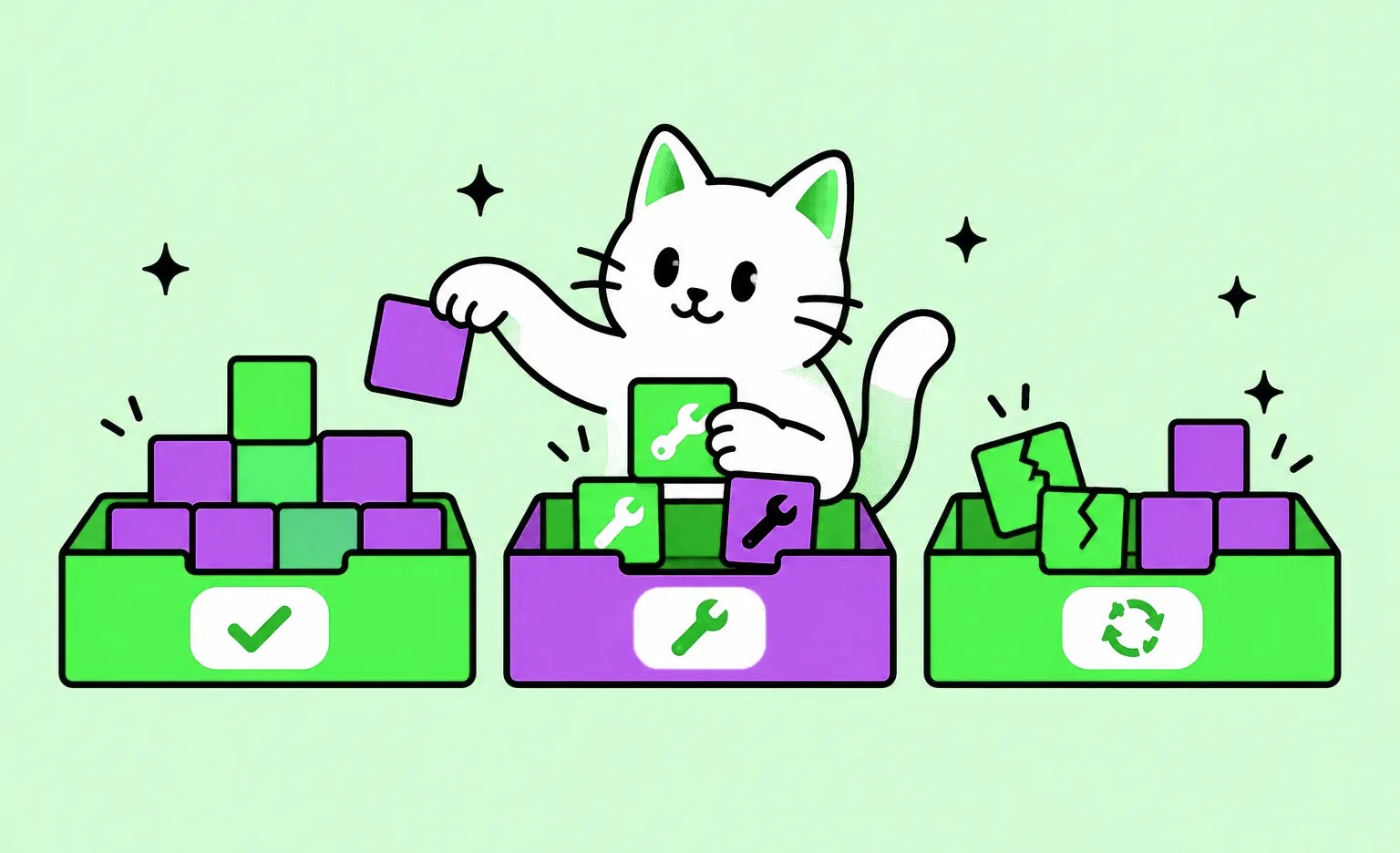
- Keep: the part works, has tests or is simple enough to change safely, and does not stand in the way of your plans, even if we would have written it differently.
- Refactor: the part does the right thing, but its structure makes changes slow or risky. It can be improved step by step while the product stays live.
- Rewrite: the part cannot be improved step by step. Signs include fixes that no longer hold, a structure where any change touches most of the system, and a framework whose support has ended.
“When a client comes to us sure they need a rewrite, sometimes they are right. But a rewrite can stop new features for months, so we want the audit to prove it is needed before anyone plans for it.”
Roman Surikov, CEO at Ronas IT
How much a code audit costs and how long it takes
A code audit with us costs $1,000-$2,000 and takes at least one week; an engineer sets its scope once they have looked through your code. If you also want us to make the fixes, a dedicated development team starts at $8,000 a month. Fixes are priced separately, from what the audit finds, because a missing access check and a new data model differ greatly in effort.
| Work | Price | Use it when |
|---|---|---|
| Code audit | $1,000-$2,000 | You need the report and the verdict before a decision, such as whether the architecture can carry a planned feature |
| Dedicated development team: two developers with AI agents and a part-time project manager | From $8,000 per month | You want us to make the fixes, your developers need outside help with some of them, or the fix plan is too big for your own team |
What sets where the audit itself falls in that range:
- Size and number of parts: a backend, a web app and two mobile apps take more work than one web app.
- Access to people: the audit covers more ground in the same time when someone who knows the code can answer questions.
- Regulation: on a fintech system, which handles money and compliance, needs deeper checks of the payment and data-access code, so its audit falls toward the top of the range.
How to choose a code audit company
Choose a team that did not build the product, works in your stack every day, and gives you a verdict. These questions help you check.
- Did you write any of this code? An audit by the team that built the product is a self-review. Ask for engineers who had no part in it.
- Which projects in our stack have you built? An auditor who does not use your framework can miss what is normal and what is not. Our stack is public in our Tech Radar, so you can check it against yours.
- How much of the review is manual? A report made only from scanner output repeats what the tools would tell you on their own. Ask which parts people will read by hand.
- What will we get at the end? Expect a verdict for each part and a fix plan with an estimate.
- Which AI services will see our code, and under whose accounts? If the auditor uses AI tools, ask which services read the repository, under what agreement, and who checks what they report.
- Is the audit priced apart from the fixes? It should be, so the report is useful even if another team does the work.
What to do next
- Write down the decision you face. A handover, a funding round, a large feature or a possible rewrite. The audit is scoped around it.
- List the symptoms. Slow screens, bugs that come back, releases that break things, and where users complain.
- Prepare read-only access. Get the code, a staging copy of the product and the build pipeline ready to share, and collect any documentation you have.
- Ask for a first look. It sets the scope, the timeline and the price of the audit.