Fixed price vs time and materials: choosing a software contract for Agile or Waterfall

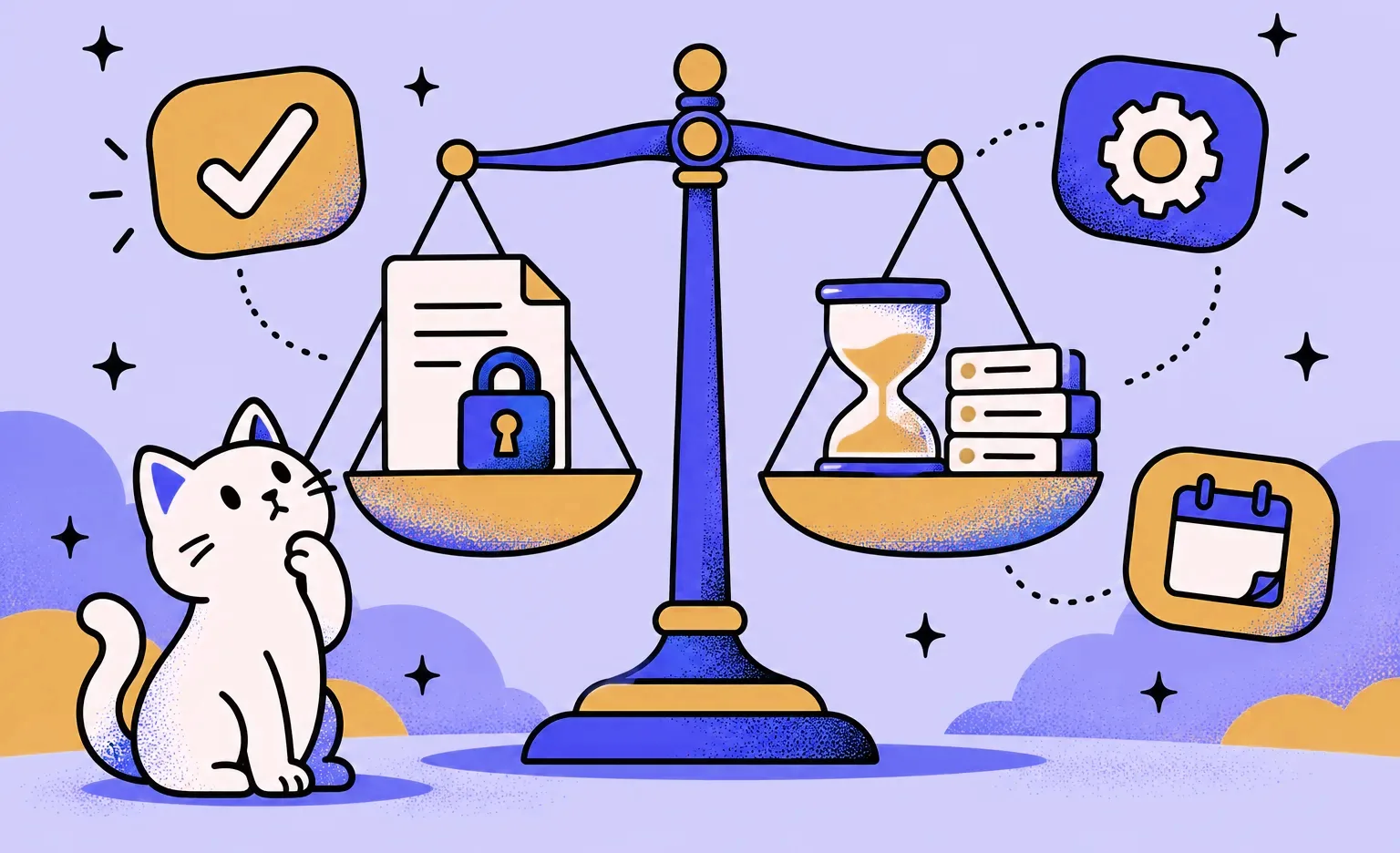
A fixed price contract sets the scope, the deadline and the total before work starts, while time and materials pays for the team's time at agreed rates, per hour or per month. At Ronas IT, the written scope that a fixed price needs, if you do not have one yet, comes from an optional analysis phase that costs $1,000-$2,000. Choose a fixed price when you can describe every feature today, and time and materials when user feedback will change the plan. Waterfall also needs full requirements up front; Agile expects change.
Fixed price vs time and materials at a glance
The two models differ in what is fixed and in who pays for the unknown. Under a fixed price, the vendor carries the cost risk and you carry the risk that the written scope is wrong. Under time and materials, you carry the cost risk and keep control of the plan.
| Fixed price | Time and materials | |
|---|---|---|
| What is fixed | Scope, deadline and total price | Hourly or monthly rates; the scope can change |
| Who pays for overruns | The vendor, inside the agreed scope | You, up to the limit in the contract |
| How a change is handled | A change request with its own estimate and approval | A new item in the backlog (the team's list of work to do), planned into a coming sprint |
| What you need before signing | Written requirements with acceptance criteria | A goal, a first backlog and a person who sets priorities |
| What you see during the work | A weekly report and a demo at each milestone, plus sprint results if the scope is built in sprints | Results of each sprint and a weekly report on progress and spending |
| Delivery method | Waterfall, or sprints inside a fixed scope | Agile methods such as Scrum, Kanban or Scrumban |
| Good fit | A landing page, a defined feature, a first release with a written scope | A product still learning from its users, new features after launch |
How a fixed price contract works
A fixed price contract names what will be built, by when and for how much, and the number does not move with the vendor's actual costs. US federal rules on contract profit say the contractor “assumes the greatest cost risk in a closely priced firm-fixed-price contract under which it agrees to perform a complex undertaking on time and at a predetermined price.” The vendor prices that risk into the quote, so a fixed price buys certainty rather than a discount.

The model works only when the scope is written down in a form both sides can test: the features, the screens, the integrations and acceptance criteria that say when each item is done. A vague line in the scope is where disputes start, because the vendor reads it narrowly and the client reads it broadly.
On our fixed-price projects, nothing outside the agreed scope is built without the client's written approval. Bug reports fall under the same rule: each one is sorted as warranty work or as a new requirement, and work on a new requirement starts only after you approve it. Each key milestone ends with a demo, live or recorded, and you then accept the result or list what to fix.
The model breaks when the scope was a guess. Each discovery during the build becomes a change request with a new estimate and a new approval, and the schedule waits at every one of them.
How time and materials works
Time and materials charges for the time the team works, at an hourly or monthly rate set in the contract, plus the actual cost of materials, which in software include paid services and licenses. US federal rules allow a time-and-materials contract only when it is “not possible at the time of placing the contract to estimate accurately the extent or duration of the work or to anticipate costs with any reasonable degree of confidence.” That is a fair test for a product that will change once users arrive.
The same rule names the weakness: this contract type “provides no positive profit incentive to the contractor for cost control or labor efficiency.” The buyer has to watch the work instead. In practice, that takes a spending limit per month or per stage, a written record of what was delivered against what was spent, and working results you can open at short intervals.
On our projects, sprints usually last one to three weeks, and each closes with a result you can look at yourself, such as a new build on the dev server. Once a week the project manager sends a written report: what was done, what value it gives you, what comes next, and the risks. The project manager also replies to messages within 24 hours on business days.
We offer time and materials as a monthly dedicated development team: a fixed monthly fee for two developers who work with AI agents, usually one on the front end and one on the backend, plus a project manager for part of the time. It starts at $8,000 per month, has no hourly billing, and can build a new product or join the process your own leads run on an existing one. The engagement is open-ended, so the limit you put in the contract is what caps the total.
Agile vs Waterfall in software development: how each fits the contract
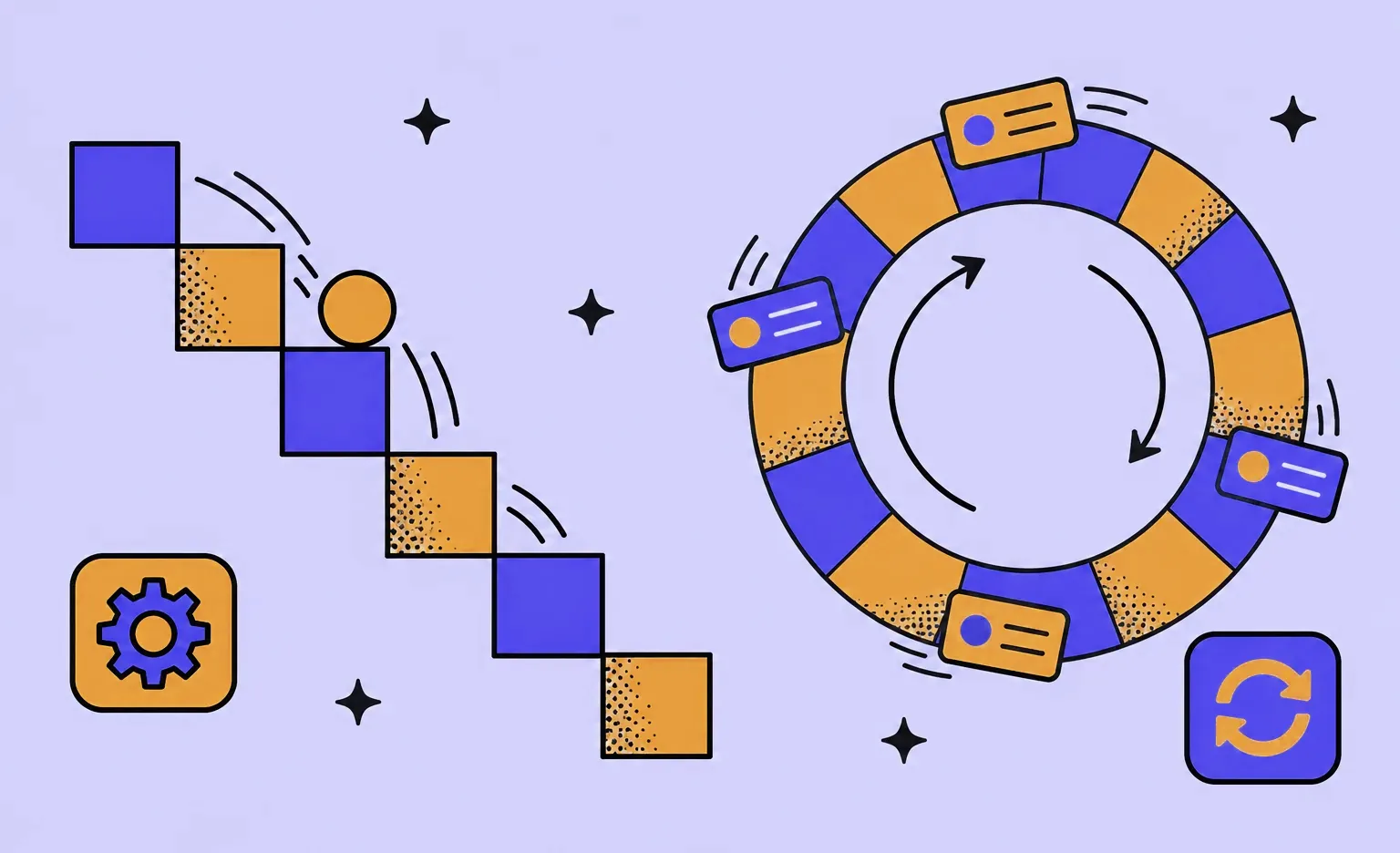
Waterfall runs a project as one sequence of phases, and Agile runs it as short cycles that each end in working software. The contract shapes which one fits. A fixed price needs the full requirements before signing, which is the first phase of Waterfall. Time and materials lets the plan change between cycles, which is what Agile assumes.
Waterfall
In Waterfall, requirements, design, development, testing and release follow one another, and each phase starts when the previous one is signed off. Winston Royce drew this sequence in a 1970 paper and wrote that, done this way, it “is risky and invites failure.” His reason was that testing comes last, so it is the first time the team sees how the system really behaves. The same paper adds steps that loop back, such as building a first version of a new program before the real one and involving the customer at earlier points.
Agile
Agile takes its name from the Manifesto for Agile Software Development of 2001, which values “customer collaboration over contract negotiation” and “responding to change over following a plan.” Scrum, one Agile framework, works in sprints that the Scrum Guide calls “fixed length events of one month or less.” Kanban does not require fixed cycles and moves each task across a board as its state changes.
What we use
Under either contract, we often run projects in Scrumban, a mix of Scrum and Kanban in which we keep Scrum's sprints. Under a fixed price, the sprints run inside the agreed scope, and any change to it needs a change request. Under time and materials, the backlog changes between sprints. We switch to Waterfall when a client wants a single result built exactly to a predefined specification.
Our project managers have read the PMBOK Guide, the project management standard from the Project Management Institute, in its sixth and seventh editions, and use it in their work; our guide to software project management shows how its practices apply to a project like yours.
“The label on the method matters less than how often the client sees working software. A team can call itself Agile and show nothing for months, or follow a fixed plan and demo every sprint. Ask how soon you will open the first build, and how often after that.”
Alexander Storozhevsky, Lead developer at Ronas IT
How the cycle changes when engineers write code with AI agents
On our projects, engineers write and test much of the code with AI agents, so typing is no longer what limits a sprint. The limits are the work people still do: describing each task precisely, reviewing what the agents produced, and accepting it. More changes fit into a sprint, which makes short sprints and a clear backlog more important, not less. Under a fixed price, the acceptance criteria written for the scope help here too, because a precise criterion is also a precise task. Under either contract, an engineer reviews and accepts every change before it reaches your demo. Our guide to Agile with AI agents covers this in more detail.
How to choose between fixed price and time and materials
Answer five questions about your project. Clear acceptance criteria and a stable plan point to a fixed price. A plan that users will change and a person who can set priorities every week point to time and materials. A mix of answers points to the hybrid in the next section.
- Can you write acceptance criteria for each feature today? If yes, a fixed price is possible. If you can only describe the goal, the scope is not ready to be priced yet.
- Will users or the market change the plan? An MVP built to test demand will change after its first users. A feature for a known internal process may not change at all.
- Is the budget a hard limit or a target? A hard limit calls for a fixed price, or for time and materials with a monthly cap written into the contract.
- Can someone on your side set priorities every week? Time and materials works when such a person decides what the next sprint builds. Without one, the team fills each sprint with its own reading of the goal.
- Is there a date you cannot move? A launch tied to an event needs a scope that fits the date. If it does not fit, cut the scope before signing rather than during the build.
A hard budget and a fixed date can also be set the other way around: fix the time and let the team shape the scope to it. Jason Fried, CEO of 37signals, calls this an appetite instead of an estimate. His argument is that most features have a 3-week, a 6-week and a 12-week version, and an estimate tends to slide from one to the next. With an appetite of four weeks, the team designs the four-week version. 37signals allows about 10% more time once per project, and stops a project that has no honest path to finishing. Under time and materials, the same idea works as a cap per feature or per stage, agreed before the sprint that starts it.
The hybrid: a fixed price for the known part, time and materials for the rest
You do not have to pick one model for the whole product. Pay a fixed price for the part you can describe, and time and materials for the part you cannot describe yet. The sequence below moves from one to the other as the product becomes clearer.
| Stage | Contract | What you get | Starting price and timeline |
|---|---|---|---|
| Analysis phase, optional: only when the scope is not written yet | Fixed price | Features written as user stories, a check that they can be built, and a scope document with an estimate of cost and time | $1,000-$2,000 in total, at least 1 week |
| First release | Fixed price for the written scope | A web MVP with its core features, design, backend and project management included | From $5,000, at least 2 weeks |
| New features after launch | Time and materials | A dedicated team: two developers plus a project manager for part of the time | From $8,000 per month |
| Keeping the system running | Monthly fee | Support: monitoring, fixes and updates for the web MVP, or for the whole system once mobile apps share its backend | Monthly fee: one app from $1,000, the whole system with its apps from $2,000 |
An analysis phase is one way to turn a goal into a scope that can carry a fixed price. The first release is where a fixed price fits a product best, because its scope is the smallest and the best described. With more features, roles and integrations, the same first release is an extended MVP that starts at $10,000 and takes at least 5 weeks. After launch, users start asking for things nobody planned, which is the moment to move to time and materials.
A quote under either model rests on stated conditions. Ours arrives with a page that lists them, such as the stack we propose and the outside services the build relies on. Under a fixed price, a change to one of those conditions goes through the contract's change procedure: it gets its own estimate, and the team starts on it only after you approve it. See how we build such a quote in our guide to estimating a website or a mobile app.
“The part of a product I am least willing to fix a price on is an integration nobody has called yet. The documentation says one thing, the sandbox does another, and you only learn which one is true from the first real request. I would rather fix the price of everything around it and keep that one piece open.”
Evgeny Leonov, CTO at Ronas IT
What to put in the contract under either model
Four clauses decide whether either model works in practice: how a change is handled, how much can be spent, how work is accepted and how progress is reported. Write each one down before signing, because each maps to a dispute that is cheap to prevent and expensive to settle.
- A change procedure: who writes a change down, who estimates it and who approves it before work starts. Under a fixed price it is the only way the scope moves. Under time and materials, it shows who approved each new backlog item and at what estimate.
- A spending limit: under time and materials, a cap per month or per stage that the team cannot pass without your approval. US federal time-and-materials contracts must include a ceiling price that the contractor exceeds at its own risk, and the same logic protects a private buyer.
- Acceptance: what “done” means for each deliverable, how you sign it off, and a rule that a rejection comes with specific comments.
- Reporting: a report in writing every week that shows what was done, what comes next and the risks, plus a demo when each milestone closes. Under time and materials, the report also shows how much of the spending limit has been used.
The rest of the agreement, from code ownership to handover at the end, is covered in our guide to the outsourcing contract and the first 90 days.
What to do next
- List the features of your first release. Mark each one you can describe with acceptance criteria today.
- Answer the five questions above. Note which model most of your answers point to, and whether a hybrid fits better.
- Write the scope before you ask for a fixed quote. If it is not written yet, an analysis phase with us takes at least one week and ends in a scope document for that quote.
- Check the four clauses before signing. Change procedure, spending limit, acceptance and weekly reporting.