Healthcare chatbot development is building a chat assistant that does one job for patients or clinic staff, such as booking visits, collecting intake answers or answering questions from approved content, connected to your scheduling and records systems and built to the privacy rules that apply, such as HIPAA. At Ronas IT, an AI chatbot starts from $3,000 and takes at least 1 week.
A chatbot that schedules visits and answers from approved text is ordinary software under privacy law. A chatbot that tells a patient what their symptoms mean is a different product: it can fall under FDA rules for medical device software, and some US states now set rules for AI that talks to patients. That difference changes the cost and risk of a healthcare chatbot.
This guide is for clinic owners, digital health founders and product leads who want a chatbot in their own product or patient channels.
What a healthcare chatbot is
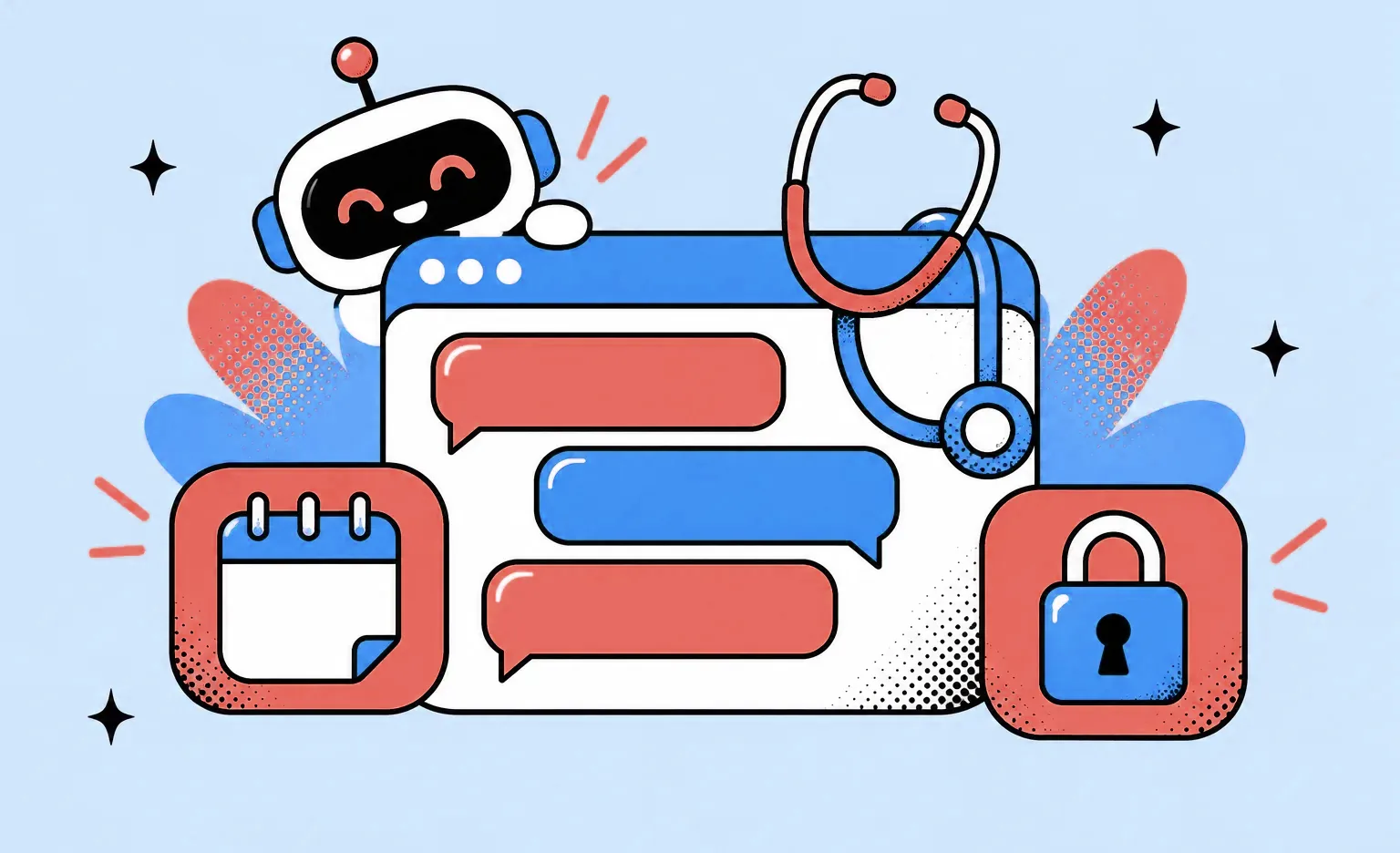
A healthcare chatbot is software that holds a conversation with patients or staff, through buttons, free text or both, and acts on the answer: it books a slot, fills in a form, sends a reminder or hands the chat to a person. It can use a large language model (LLM) to understand free text, but the model is only one part. The rest is code that decides what the bot may do, the systems it reads and writes, and when a person takes over.
| Approach | How it works | Where it fits | Main risk |
|---|---|---|---|
| Rule-based | Buttons and fixed flows; every answer is written in advance | Booking, intake forms, reminders, opening hours | Users give up when their question is not in the menu |
| LLM with retrieval (RAG) | For each question, the system finds passages in your approved content, and the model writes the reply from them | Questions about services, insurance, billing and preparing for a procedure | A fluent answer that is wrong |
| Hybrid | The model understands free text; fixed code books slots, checks identity and handles anything urgent | Patient chatbots that take free text and also book, change records or route urgent cases | More parts to build and test |
We recommend the hybrid when a patient chatbot both answers free-text questions and takes actions, such as booking a slot or flagging an urgent case. A patient can write in their own words, and every action that changes a record or could harm someone runs through code that behaves the same way each time. Our guide to generative AI integration explains retrieval and the other ways to connect a model in more detail.
What AI chatbots in healthcare can do for patients and staff
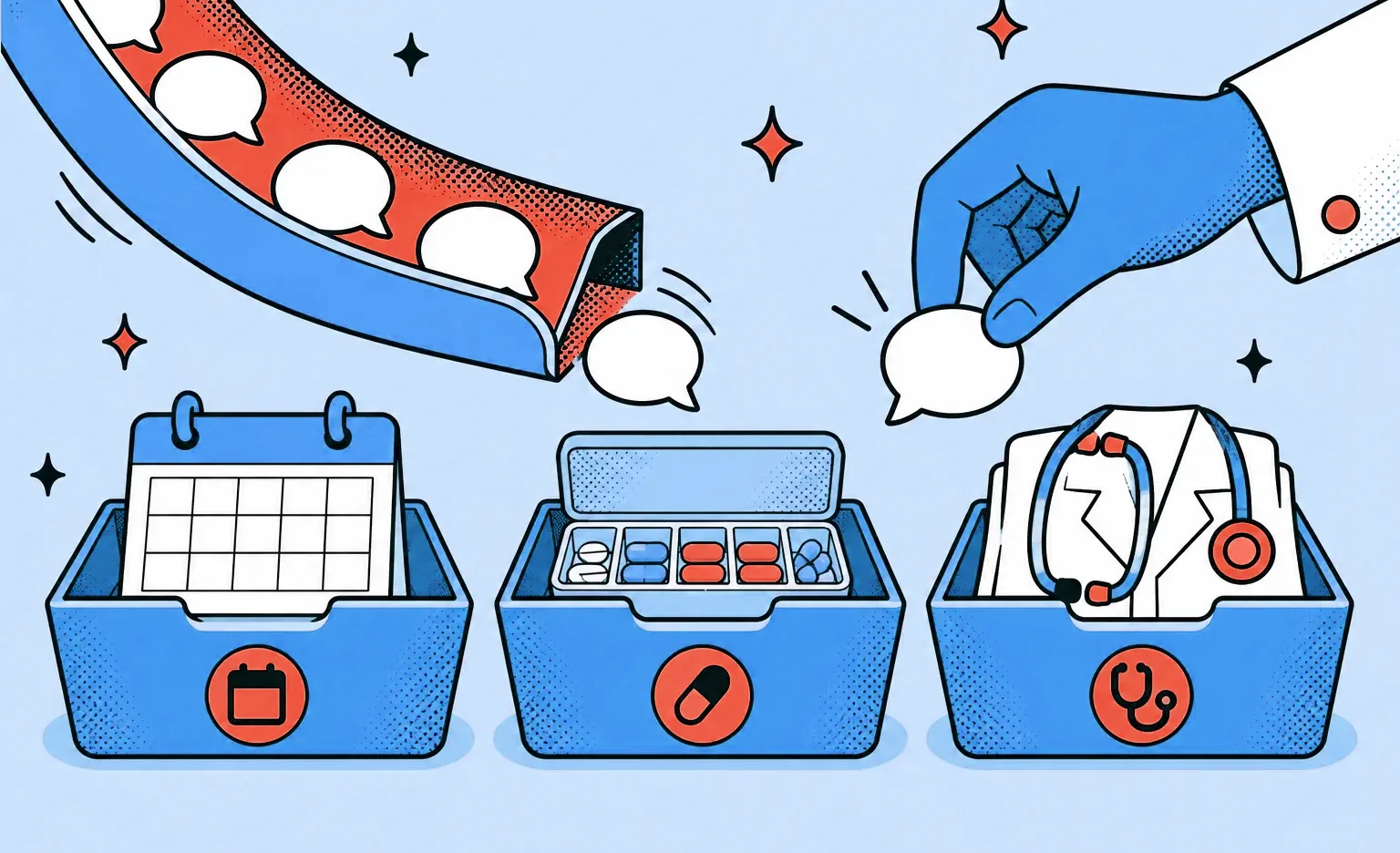
The safest and most useful tasks are administrative, such as booking, reminders and intake. Clinical tasks, such as checking symptoms or giving mental health support, are possible, but they can bring medical device rules and need clinical review and far more testing. If your idea depends on the bot giving medical advice, plan for a regulatory path from the first week, not after launch. Start with a task where your staff already has the right answer written down.
| Task | What the chatbot does | Systems it needs |
|---|---|---|
| Booking and rescheduling | Finds a free slot by doctor, location and visit type, books it and sends a confirmation | Scheduling system or EHR |
| Reminders | Reminds patients about visits and the preparation steps the care team set | Scheduling system, SMS, email or push notifications |
| Intake before a visit | Collects the reason for the visit, insurance details and consent forms | EHR or practice management system |
| Questions about services, insurance and preparation | Answers from approved text and links to the page it used | Knowledge base or website content |
| Refill requests | Takes the request and passes it to staff, who decide | EHR, staff inbox |
| Policy lookup for staff | Answers from internal protocols and policies and shows the source | Document storage |
| Sorting patient messages | Sorts incoming messages by topic and drafts replies that staff approve | Patient portal, staff inbox |
Rules that apply to a healthcare chatbot
In the US, the federal rules that can apply to a healthcare chatbot include HIPAA, if you are a covered entity or work for one; FDA rules, if the bot gives patient-specific medical advice; and the FTC Health Breach Notification Rule for health apps outside HIPAA. Some states add rules for AI that talks to patients and for health data outside HIPAA. Your regulatory adviser decides which rules apply to you; the build has to support them.
HIPAA and the model provider
Under HIPAA, a vendor that creates, receives, maintains or transmits protected health information on behalf of a covered entity is a business associate and must sign a business associate agreement (BAA). For a chatbot, such vendors include the cloud that hosts the backend, the language model provider, an SMS service that stores messages and any tool that stores chat transcripts. HHS guidance on cloud computing says a cloud provider that stores health data for a covered entity is a business associate even if it stores only encrypted data and has no key.
Model providers sign BAAs only for some services and settings. OpenAI says that to use its API with protected health information you first need a BAA and that most API services are covered. OpenAI does not offer one for ChatGPT Business. Anthropic's BAA covers its first-party API, but not every API feature. Read which products and settings the agreement covers before you send real patient data, and keep consumer chat apps out of the workflow.
If your clinic already has a BAA with a cloud provider, the same cloud can serve the model. Amazon Bedrock is on the AWS list of HIPAA-eligible services. Google Cloud lists generative AI on its Gemini Enterprise Agent Platform, formerly Vertex AI, among the products its BAA covers. Check that the exact model and features you plan to use are on the provider's list for your account.
A third route keeps patient data away from model providers altogether: an open-weight model, such as Llama or Gemma, runs on servers in your own cloud account, for example through Ollama. The cloud that hosts those servers still signs a BAA. A Tighten guide to self-hosted models names the price: no access to the strongest proprietary models, and GPU servers for the larger open ones. Test an open model on your own questions before you choose this route.
FDA rules for medical advice
A chatbot that analyzes a patient's symptoms or data to suggest a diagnosis or treatment can be a medical device. FDA's guidance on clinical decision support software (January 2026) explains when software that gives recommendations to clinicians who can independently review the basis of the advice is not a device. The same kind of software giving these recommendations to patients or caregivers, not clinicians, meets the definition of a device. FDA's guidance on device software functions and mobile medical applications names some lower-risk functions for which the agency does not, at this time, intend to enforce device requirements.
Booking, reminders and answers about your services are not medical advice. Our guide to medical device software development explains what changes in the process when a product is a device.
Rules for health apps outside HIPAA
A health app that collects health data directly from consumers, without a covered entity behind it, may be outside HIPAA but not outside federal rules. The FTC's Health Breach Notification Rule requires vendors of personal health records that HIPAA does not cover to notify users, the FTC and, in some cases, the media after a breach of health data. Amendments that clarified its use for health apps took effect on July 29, 2024.
States add their own rules for such data. Washington's My Health My Data Act protects health data that falls outside HIPAA from being collected and shared without the consumer's consent, and a violation can be enforced by the state Attorney General and through private lawsuits. If such a chatbot talks to people in Washington, agree with your adviser where it asks for consent and how it keeps a record of each answer.
State rules for AI in patient communication
California's AB 3030 requires health facilities, clinics and physician offices that use generative AI to write patient messages about clinical information to add a disclaimer and tell the patient how to reach a human. In a chat, the disclaimer stays visible for the whole conversation. The rule does not apply when a licensed provider reads and reviews the message first, and the Medical Board of California says it applies from January 1, 2025.
In August 2025, Illinois prohibited using AI for mental health and therapeutic decision-making. Licensed behavioral health professionals can still use AI for administrative and supplementary support. Check the rules in the states where your patients live.
The architecture of a safe healthcare chatbot
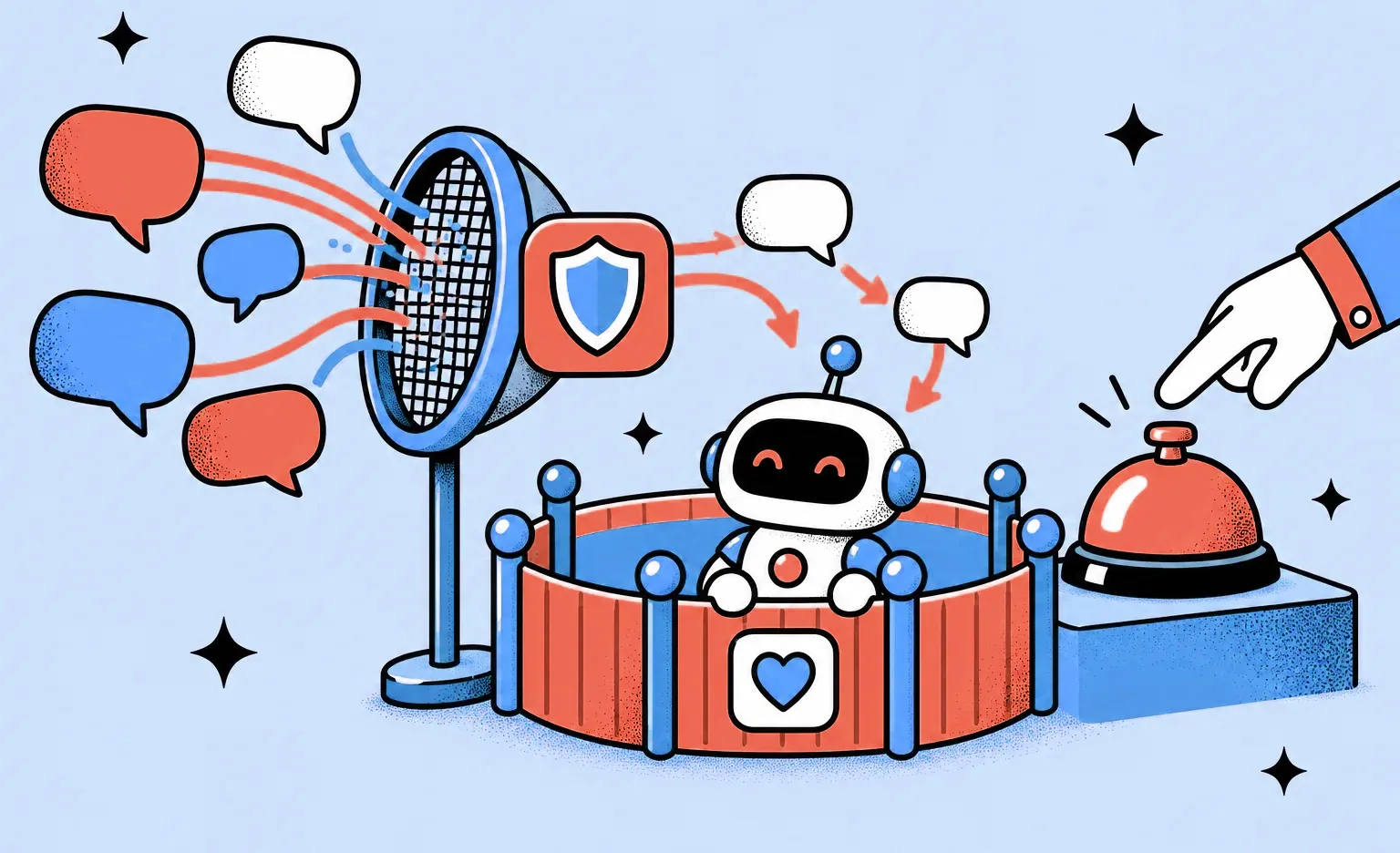
A safe healthcare chatbot keeps the model behind your backend, gives it only the data one task needs, answers emergencies with a fixed message, and hands over to staff when the bot is unsure.
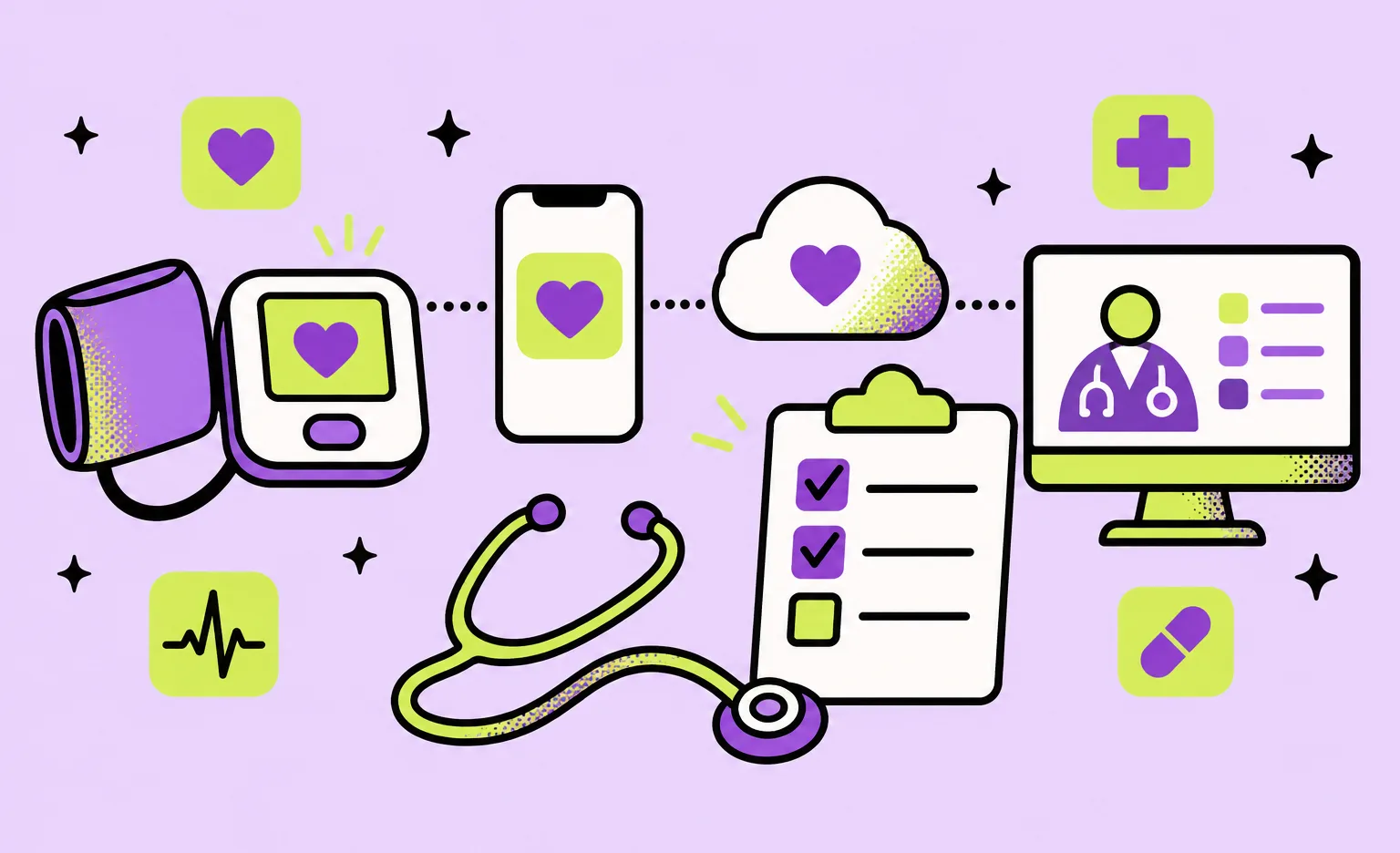
- Channels: a website widget, the patient app, SMS or the patient portal. All of them talk to the same backend, so the rules are the same everywhere.
- Emergency check first: a separate check runs on every message before the model. If it finds signs of an emergency, the bot sends a fixed message that tells the person to call 911 or the 988 Suicide & Crisis Lifeline and alerts staff.
- The model behind the backend: the app never calls the model directly. The backend adds the instructions and the approved content, calls a model covered by the provider's BAA, checks the reply and stores a record of the call.
- Approved content only: answers come from passages your clinical or operations lead has approved, and the bot shows which page it used. Topics outside that content get a polite refusal and a way to reach a person. The clinic answers for what its bot says. In February 2024, a British Columbia tribunal held Air Canada liable for a website chatbot that told a passenger he could claim a bereavement fare after travel, against the airline's own policy page.
- Narrow permissions: the bot can create an appointment but cannot change a diagnosis or a medication list. It confirms the patient's identity before it shows any personal data.
- EHR access through FHIR: EHRs certified to the US Base EHR definition must offer a standardized API based on HL7 FHIR, so the chatbot can read data such as medications through that API rather than a custom export.
- Handoff to a person: staff get the whole conversation, so the patient does not repeat everything.
- Logs and retention: every access to patient data is logged, transcripts are kept only as long as you need them, and analytics and error-tracking tools never receive health data.
“Give the emergency check its own tests, so a new prompt or a model upgrade cannot switch it off. It must also keep working during an outage at the model provider: a patient who writes about chest pain should still get the emergency message.”
Alexander Storozhevsky, Lead developer at Ronas IT
On a web platform for analyzing lab test results, we built security controls to HIPAA requirements: two-factor authentication for administrators, automatic logout after a period of inactivity, an updated lifespan for sign-in tokens, alerts and longer backup retention. We have also connected the OpenAI API to an in-app assistant, on a marketplace app in the UAE. A healthcare chatbot needs both: a model built into the product, and the controls around patient data.
How to build an AI chatbot for healthcare, step by step
Our process for a healthcare chatbot has six steps, from one chosen task to a staged rollout.
- Pick one task and one measure. Name the task and what should change, such as the share of bookings made by phone or the number of missed visits.
- Map the data and the rules. List the data the bot needs, every vendor that touches it and whether each one signs a BAA. Our estimate lists the third-party services the build relies on, which gives you the start of that list. Your regulatory adviser checks whether any feature could count as medical advice.
- Write the content and the conversation. Your clinical or operations lead approves the answers, the topics the bot refuses, the emergency message and the rules for handoff.
- Collect a test set. Save real questions with personal details removed, each with the answer you expect. Add emergencies, off-topic requests and attempts to talk the bot out of its rules, which OWASP lists as prompt injection, the first risk in its Top 10 for LLM applications.
- Build in sprints. Our sprints usually last one to three weeks, and each ends with something you can open and check on a test server.
- Pilot, then roll out in stages. Staff use the bot first, then a share of patients. Each week, someone reads a sample of conversations, and every wrong answer becomes a new case in the test set. Test with real people as well as with saved questions, because a model's right answer does not mean the patient understands it. In a randomized study in Nature Medicine (February 2026), language models tested alone identified the right conditions in 94.9% of cases across ten medical scenarios. Members of the public who used the same models identified relevant conditions in fewer than 34.5% of cases.
“Budget your own team's time as well as ours. Somebody on your side has to own the bot's answers before launch and long after it, and that job needs real hours in their week. Without that owner, a chatbot stops getting better soon after it goes live.”
Roman Surikov, CEO at Ronas IT
How much healthcare chatbot development costs
At Ronas IT, AI chatbot development starts at $3,000 for one chatbot in a product you already run. Connecting it to your scheduling system and EHR is quoted in the same estimate and raises it with the number of systems. A new patient app or clinic platform with a chatbot inside that stores patient records under HIPAA is a healthcare product from $30,000 for its first client platform, such as a mobile app; a new app without regulated records is priced as an MVP or a complex product.
| Part of the project | When it is needed | Starting price | Timeline |
|---|---|---|---|
| Analysis phase: the chatbot's task as user stories, a feasibility and architecture review, and a written scope | Optional, before the build, if the scope is not written down | $1,000 to $2,000 | At least 1 week |
| AI chatbot development: the assistant on your website, app or messenger, with its connections to systems such as scheduling and the EHR | For the chatbot in a product you already run | From $3,000 | At least 1 week |
| API development: a new API for a system you run | When a system the chatbot needs has no API yet | From $2,500 | At least 2 weeks |
| Healthcare app or platform: a new patient app, portal or clinic system | When the chatbot is part of a new product that stores patient records under HIPAA | From $30,000 for one client platform | At least 10 weeks |
| Support and maintenance: monitoring, fixes and updates for the live product, the chatbot included | Optional, a monthly plan once the chatbot is live | From $1,000 per month for one app or portal, or for the chatbot on your website; from $2,000 for a system with several client apps | Ongoing |
Every price in the table includes project management and testing. The safeguards described above, such as the emergency check, identity checks, access logs, handoff to staff, the test set and the pilot, add to the chatbot's scope and are estimated after scoping. A chatbot that gives medical advice needs its own quote, because FDA device rules can apply and change how it is built and tested. For a new healthcare product, the chatbot is priced as part of the whole product.
Some costs come from other vendors, and you pay them directly. The model provider bills usage by the amount of text in and out, the cloud provider bills hosting, and an SMS service bills each message. Legal and regulatory review stays with your regulatory adviser and is not part of our quote.
What to do next
- Choose one task from the table above and name the measure it should change.
- List the systems the bot must read or write and check that each one has an API.
- Ask your regulatory adviser which rules apply: HIPAA, FDA rules if the bot gives medical advice, and the states where your patients live.
- Collect patient questions from phone and email logs, with personal details removed, with the answer your staff gives today.
- If the scope is not written down yet, consider an optional analysis phase to turn these answers into a scope, a budget and a timeline.


Frequently Asked Questions (FAQs)
What is a healthcare chatbot?
It is software that holds a conversation with patients or clinic staff, through buttons, free text or both, and acts on what they choose or write: it books a visit, collects intake answers, sends reminders, answers questions from approved content, or passes the conversation to a person. It can use a language model to understand free text, while fixed code handles bookings, identity checks and anything urgent.
How are chatbots used in healthcare?
Chatbots in healthcare do administrative work: booking and rescheduling visits, reminders, intake before a visit, questions about services, insurance and preparation, and refill requests passed to staff. Staff can use them to look up internal policies and to sort patient messages. Symptom checking and mental health support also exist, but they can bring medical device rules and need much more clinical testing.
How do you build a medical chatbot?
Start with one task, such as booking visits or intake, and one measure it should change, such as missed visits. List the data the bot needs and every vendor that touches it, check that each one signs a BAA, and ask your regulatory adviser whether any feature gives medical advice, which can bring FDA rules for medical devices. Then test the bot on anonymized questions with known answers, and let staff use it before patients do.
How much does it cost to build a healthcare chatbot?
At Ronas IT, an AI chatbot for your existing website, app or patient portal starts at $3,000, and each system it connects to, such as your EHR, raises the estimate. Project management and testing are included, and you pay the model and cloud providers for usage and hosting.
How long does it take to build a healthcare chatbot?
An AI chatbot takes at least 1 week with us, and its connections to other systems add time with their number. A pilot with staff before patients see the bot adds time that depends on how many conversations you want to review.
Can we use ChatGPT or another language model with patient data?
Not through a consumer chat app. If the chatbot handles protected health information for a covered entity, the model provider counts as a business associate, and a business associate agreement (BAA) has to be signed with it first. OpenAI and Anthropic offer BAAs for their APIs, each with conditions, but OpenAI does not offer a BAA for ChatGPT Business.
Is a symptom checker chatbot a medical device?
It can be. Under FDA guidance, software that analyzes a patient's information to recommend a diagnosis or treatment can be a medical device, and FDA's January 2026 guidance on clinical decision support software says that such software giving recommendations to patients or caregivers, not to clinicians, meets the definition of a device, though FDA does not intend to enforce device requirements for some lower-risk functions. Your regulatory adviser should decide this before the build starts, because the answer changes the process and the cost.
Can a healthcare chatbot connect to our EHR?
Usually, yes. An EHR certified to the US Base EHR definition has to provide a standardized HL7 FHIR API, which a chatbot can use to read data such as medications with the patient's or the clinic's permission. Check your product's certification listing before the scope is set, because vendors choose which criteria they certify. Writing data back depends on what your EHR vendor allows. If a system you run has no API, building one with us starts at $2,500.
How do you stop a medical AI chatbot from giving dangerous answers?
You cannot make it perfect, but you can limit the damage. Check every message for signs of an emergency before the model sees it, let the model answer only from content your clinical team approved, block topics the bot must not discuss, test each change on a saved set of anonymized and difficult questions, and pass the conversation to a person when the bot is unsure.