

A good shop assistant listens to what a customer needs, points out matching products, flags a deal, and often grows the size of the basket. An e-commerce recommendation engine does the same job at scale: it suggests relevant products to each shopper, keeps them engaged, and drives more sales for your store.
This guide walks through how to build a recommendation system step by step. It also answers a question many teams skip: whether your engine needs to be AI-powered at all, or whether a simpler, rule-based approach will do the job faster and cheaper. Building either one well is a custom software development job, so it pays to pick the right approach before you start.
What is an e-commerce recommendation engine, and how does it work?
An e-commerce recommendation engine is a system that online retailers use to suggest products to customers based on their preferences and past interactions. It analyzes data such as browsing and purchase history to predict what a shopper might want, then displays relevant product suggestions. It usually runs as a separate system that integrates with your existing store.
These systems follow a standard workflow: they collect customer data, analyze it to find patterns, run algorithms to generate recommendations, and display those recommendations to users.
McKinsey's research on personalization found that it can lift revenue by 5 to 15% while cutting customer acquisition costs by as much as 50%. Recommendations are one of the most direct ways to deliver those personalized customer experiences, which is why teams build them into their e-commerce development solution.
How leading apps use recommendation systems
Recommendation systems are useful well beyond e-commerce stores and custom marketplace development projects. Here is how a few well-known products put them to work.
Amazon
Amazon has worked on product recommendations for more than two decades. Its systems use customer behavior and item relationships to help shoppers discover products they might not find on their own. Amazon's retrospective on its recommender systems describes how that work evolved from item-to-item collaborative filtering into more personalized models.
Best Buy
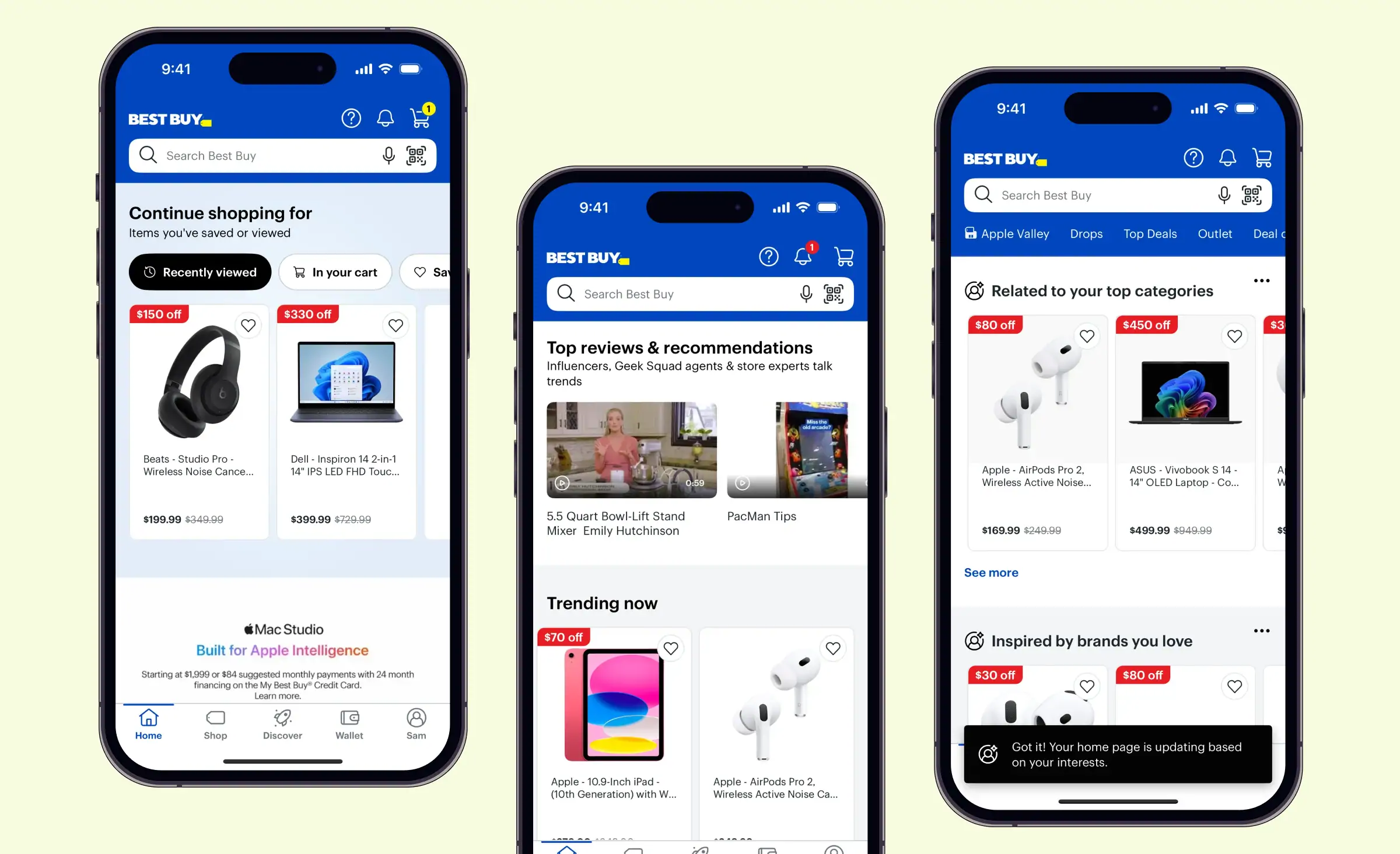
Best Buy uses AI to personalize its app home screen. The company says the experience adapts to customer preferences, shopping history, membership status, and other signals. It can show deals, new products, and product or service recommendations that differ from one customer to another.
Airbnb
Airbnb also applies machine learning on the host side of its marketplace. Its Attribute Prioritization System extracts home attributes from guest messages, reviews, support tickets, and listing descriptions. Airbnb uses those signals to rank which amenities and location details matter for a particular home, then advises hosts on what to add, verify, or describe more clearly.
Uber Eats
Uber Eats uses a two-tower embeddings system. One tower represents the eater and their context; the other represents stores and their attributes. The model retrieves likely candidates before downstream rankers order them for the home feed. Uber explains the architecture in its engineering write-up on two-tower embeddings.
The recommendation layer is only part of the product. Storefront teams also need to decide whether to build a web experience or an e-commerce app with React Native.



How to choose the right recommendation approach: a model-selection rubric
Most of the examples above run on machine learning, and custom AI software can deliver highly personalized recommendations. Such systems are expensive to build and maintain, and they are not the only option. The first decision is not how to build an engine, but which approach fits your data, budget, and stage. The rubric below maps each approach to the situation it serves best.
| Approach | How it works | Best when | Watch out for |
|---|---|---|---|
| Rule-based (non-AI) | Predefined if-then rules set by the business, e.g. “if a shopper buys toothpaste, offer a toothbrush.” | Small catalog, tight budget, need for tight control and quick changes. | Rules do not adapt on their own and grow hard to manage at scale. |
| Tag-based (non-AI) | Each item is tagged with properties (season, style, color, price); the system matches items sharing tags. | Stable catalog that does not expand too fast; clear product attributes. | Every new item must be tagged manually before it can be recommended. |
| Sales-history (non-AI) | Suggests items frequently bought by shoppers who bought the same initial item. | Established stores with reliable purchase data and a modest catalog. | Slow on large catalogs; can over-recommend popular but unrelated items. |
| Collaborative filtering (ML) | Recommends items liked by users with similar behavior, without analyzing item content. | Rich user-item interaction data (ratings, clicks, purchases) is available. | Struggles with brand-new users and items that have no interaction history. |
| Content-based filtering (ML) | Builds a user profile and matches it to item attributes the shopper liked before. | You have detailed item properties but limited cross-user data. | Tends to recommend more of the same and misses unexpected discoveries. |
| Hybrid filtering (ML) | Combines collaborative and content-based signals to cover more recommendation scenarios. | Large stores with the data and engineering resources for a complex system. | Highest cost and complexity to build, train, and maintain. |
A few conditions consistently point toward the simpler, non-AI approaches. A machine learning model needs fuel: with a limited dataset, it leans on guesswork rather than real patterns, so a small shop is often better served by rule-based logic. Simpler algorithms also win when the budget is tight, when you need to launch fast, when the business wants tight control over what gets recommended, when requirements change frequently, or when stakeholders need to see exactly how each recommendation was generated.
You can see the same pattern in our own work. On an Australian eco-cosmetics marketplace we built as an MVP, the discovery experience leaned on non-ML surfaces: search with detailed filters, a catalog of top-rated products and popular categories, and a recently-viewed row. For a young multi-vendor marketplace still gathering its first interaction data, that covered the core need.
“Even when we launch a store with rule-based recommendations, we log every click, view, and purchase from day one. That way the move to a machine learning model later is a data problem we have already solved, not a rebuild. The teams that struggle are the ones that bolt on tracking only after they have decided they want AI.”
Alexander Storozhevsky, Lead Developer at Ronas IT
Simpler algorithms assume shoppers already know what they want and can describe it. That is not always true. Sometimes the best recommendation is one the shopper never considered. A machine learning system can surface those discoveries: it looks beyond single clicks to the sequence of actions, finds patterns, and suggests non-obvious options. With AI integration, a business can use those predictions across more placements as its catalog, interaction data, and user base grow.
Should you build a custom engine or use an out-of-the-box solution?
You can build a recommender with an out-of-the-box tool or as a custom system. Popular ready-made options include Recombee, Algolia, Clerk.io, and others. They deploy faster than custom solutions, need no deep engineering, and offer features like real-time analytics and integrations with common e-commerce platforms.
The trade-off shows up as you grow. Ready-made tools have limited customization and may not fit your specific needs. As the business expands, they can be hard to adapt to new requirements, such as integrating with other systems or supporting new data types. A custom engine costs more up front but removes those ceilings. If you decide to build a custom AI-powered engine, the sequence below is the path we follow.
How to develop an e-commerce recommendation engine: step by step
Step 1: Define objectives
Start by defining what the engine should achieve so it aligns with your business goals: more sales, better retention, higher engagement, or greater satisfaction. Then outline the scope, prioritize features by potential impact, and map what customer data is available. That understanding shapes the architecture of the system.
Step 2: Collect data
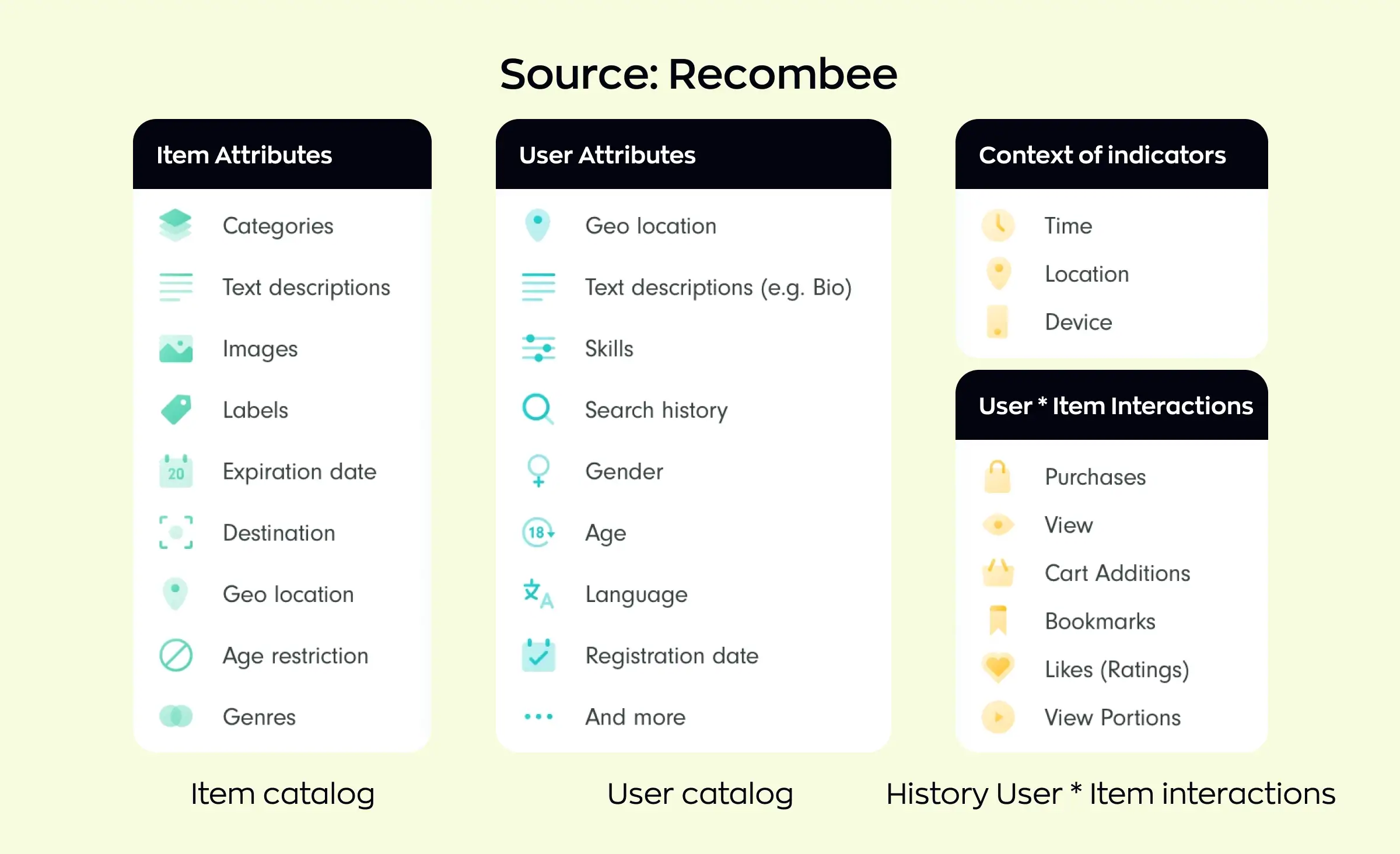
A machine learning engine needs training data to identify patterns and make precise recommendations. Gather it across three areas:
- Properties of goods: a database of all catalog items, both in-stock and out-of-stock, with categories (especially for multilayered catalogs where items belong to several categories). Text descriptions help for items with few interactions, and images let you train models on visual similarity.
- Properties of users: user location, search history, and profile interests. This gives you something to recommend even to new users who have not interacted with products yet.
- Interactions between users and goods: the most critical dataset. Ratings, browsing history, clicks, content interactions, and purchase history feed user profiles and behavior models, which form the basis for personalized recommendations.
Once gathered, the data needs cleaning of inaccuracies and standardizing into consistent formats before it is ready to train your engine.
Step 3: Choose a recommendation algorithm
This is where the rubric above pays off. For a machine learning engine, you are choosing among three core algorithms:
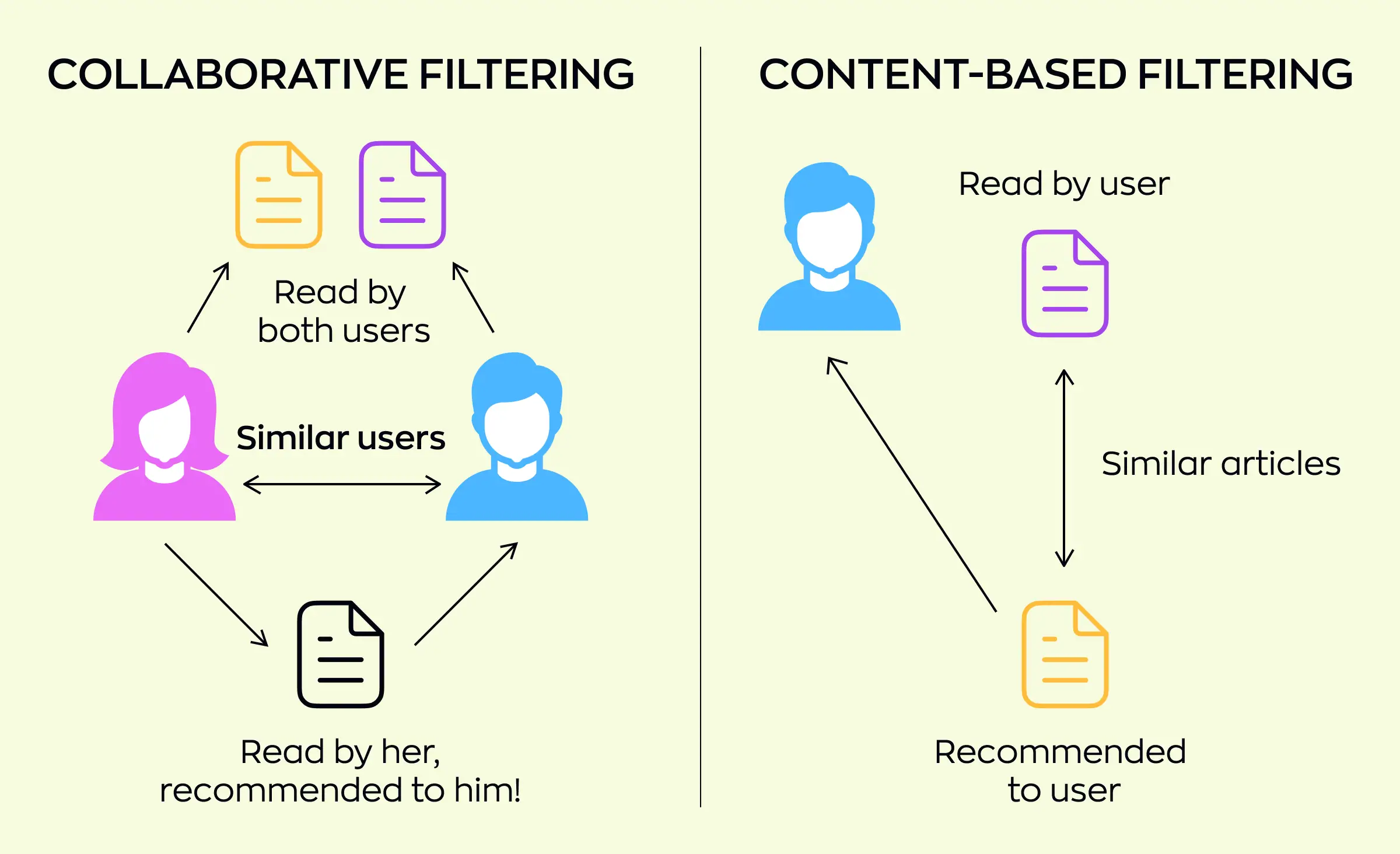
- Collaborative filtering recommends items based on the preferences of similar users, relying on behavior rather than item content. It needs a user-item interaction matrix of ratings, clicks, and purchases. Netflix uses it: if users A and B liked the same series, the system suggests to B another series A enjoyed.
- Content-based filtering recommends items based on the attributes of items a user liked before, building a profile from item properties. It needs extensive data on item properties. Netflix also uses this to suggest series in similar genres.
- Hybrid filtering combines both methods, drawing on past interactions and item properties at once. It can outperform either method when both sets of signals are useful, but the result depends on the data, objective, and implementation. The added infrastructure also costs more to run and maintain.
Whichever you pick, plan for the cold-start problem: a new user or a newly added product has no interaction history for collaborative filtering to work with. A common fix is to fall back to content-based or popularity-driven suggestions for newcomers, ask for a few explicit preferences at sign-up, and shift to collaborative filtering as interaction data accumulates.
Step 4: Develop and train the model
Engineers build the model using machine learning frameworks such as TensorFlow, PyTorch, and scikit-learn. They split your customer data into training, validation, and testing sets, feed the training data in to start learning, and fine-tune hyperparameters to optimize performance.
Step 5: Validate and test
Evaluate the model on a validation set, distinct from the training data, to tune hyperparameters and prevent overfitting, checking that it generalizes to new, unseen data. Match the metric to the task. For top-K retrieval and ranking, use measures such as precision@K, recall@K, or NDCG; for explicit rating prediction, RMSE may be useful. Then run final evaluations on the test set and involve non-technical stakeholders to judge whether the recommendations make sense in real scenarios.
Step 6: Integrate the engine into the app
Once the engine is trained, integrate it with the app or website. Developers set up API endpoints for key functions like retrieving recommendations and updating catalogs, using RESTful principles for clean communication. Building and wiring that interface calls for solid backend development services. Recommendation results are then surfaced in the frontend UI so suggestions appear clearly on product pages, checkout pages, and personalized dashboards.
Step 7: Deploy and monitor
Deploy on scalable infrastructure using cloud platforms such as AWS, Google Cloud, or Azure, with containerization through Docker and orchestration through Kubernetes so the system handles variable traffic. After launch, monitor continuously: tools like Prometheus and Grafana track latency, throughput, and error rates for real-time insight. A common rollout pattern is to release recommendations to a small slice of traffic first, then expand while A/B testing against a holdout and watching click-through rate and average order value at each placement (product page, cart, checkout, email). Run regular performance reviews and use that feedback to refine the algorithms over time. Our guide to e-commerce platform scalability covers the load-testing and infrastructure work around this rollout.
Data security and privacy
Rule-based and machine learning systems can both process personal data, and either can expose it when sensitive attributes or business logic reach client-side code. Keep recommendation logic on the server, restrict access to raw events and profiles, and return only the recommendation results the interface needs.
Training on aggregated behavior does not automatically make a model anonymous. The European Data Protection Board says anonymity must be assessed case by case: a model should be very unlikely to identify a person or allow their personal data to be extracted through queries. The EDPB opinion on AI models also makes clear that the lawful basis for processing still matters.
Before collecting recommendation data, define the purpose and lawful basis, minimize the fields you use, set retention periods, explain profiling to users, and support their data rights. Pseudonymization, access controls, encryption, and audit logs reduce risk, but they do not replace those obligations. A data protection impact assessment may also be required when profiling is likely to create a high risk to people.
Wrapping up
A recommendation engine can lift sales and deepen customer loyalty. You can add one to your store with an out-of-the-box tool or through custom development. A custom engine means setting clear objectives, gathering and preparing data, choosing the right algorithm, building and training the model, integrating it into your platform, and monitoring it in production.
The single most useful decision is the one this guide opened with: match the approach to your data, budget, and stage before writing any code. Start simple when the data is thin, and move to machine learning once the interaction data justifies it.
Many of these steps demand specialized skills in machine learning, data processing, and integration, so teams building their first engine, from established enterprises to those focused on MVP development for startups, often bring in a partner who has done it before. Our team has added recommendation engines to existing stores and built AI-powered products from scratch, and we can help you choose an approach and ship a system that holds up in production.
Frequently Asked Questions (FAQs)
What is an e-commerce recommendation engine?
Does a recommendation engine have to use AI?
What data do you need to train a recommendation engine?
Which recommendation algorithm should I choose?
Should I build a custom engine or use an out-of-the-box solution?
How do you measure whether a recommendation engine works?
What privacy controls should an e-commerce recommendation engine use?
Related posts







Related Services
MVP Development Services
Need to launch your startup quickly? Ronas IT offers urgent MVP development services, allowing you to get a fully-functional app in 4 to 12 weeks, depending on scope. Ideal for testing business ideas, presenting to investors, or entering the market swiftly. Benefit from our extensive experience and accelerated development process.
AI Software Development Services
We deliver custom AI solutions, including generative AI, chatbots, predictive analytics, and recommendation systems. From strategy to integration and ongoing support, our expert team ensures secure, scalable, and value-driven AI applications tailored to your needs, so you can innovate faster and stay ahead of the competition.
Custom Web App Development Services
Build secure, scalable web applications with Ronas IT’s custom web app development services. Our team covers the full cycle — from concept and UI/UX design to development, testing, and ongoing support — using leading tech like React and Laravel. With 200+ custom apps delivered across various industries, we ensure intuitive interfaces, smooth integration, and solutions tailored to your business goals.