An AI development company builds software that uses language models or machine learning, from chatbots and agents to models trained on your own data. The six companies below sell this work as a service: Ronas IT, InData Labs, AI Superior, Master of Code Global, MobiDev, and Azilen. Choose on evidence you can check: an AI feature built into a finished product, a clear answer about where your data goes, and a plan for testing the model's answers.
What AI development companies do
This guide sorts AI projects into four kinds of work, and one company may sell all four under different names. Knowing which kind you need tells you which companies to call and which past projects to ask them about.
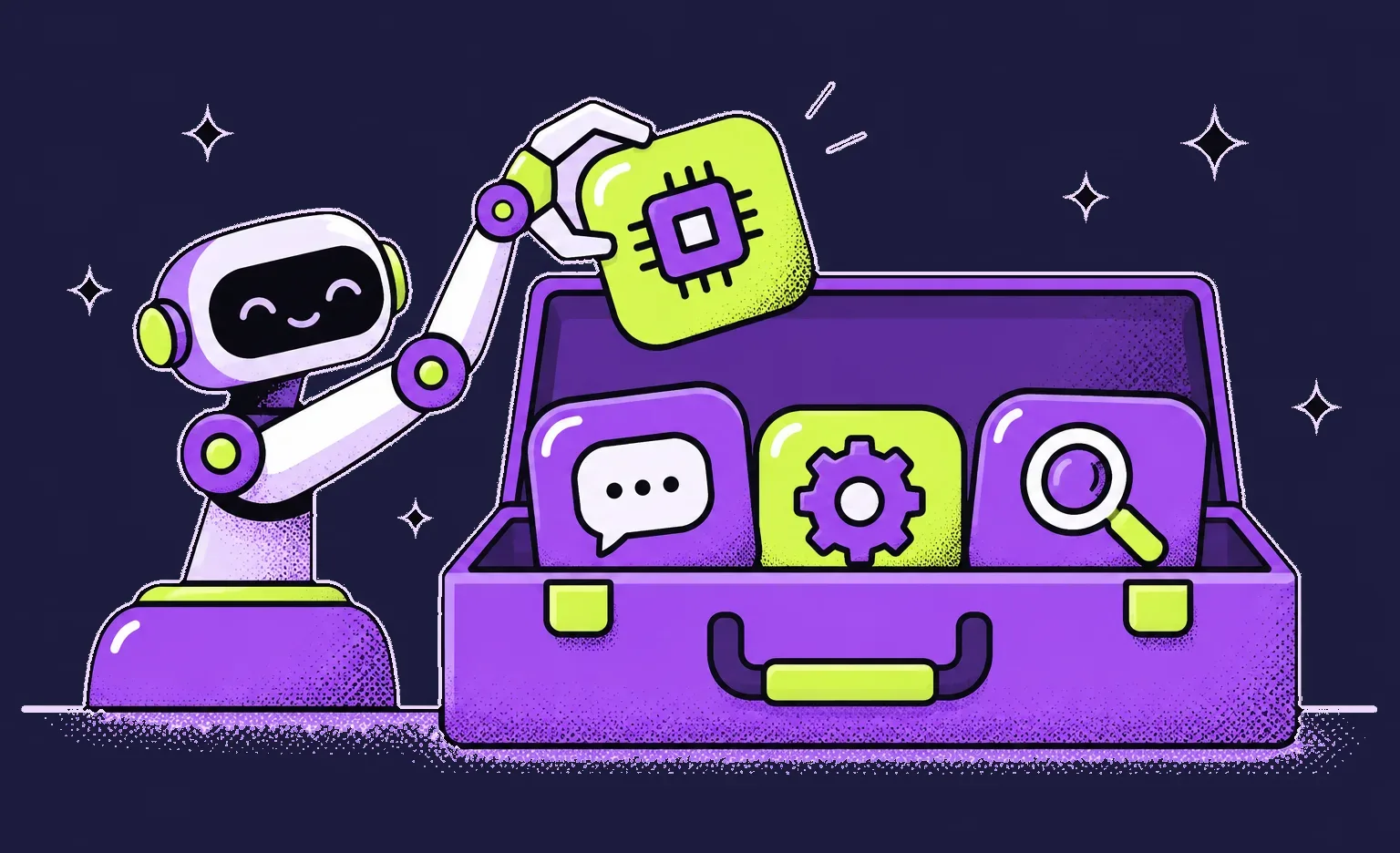
- AI integration: your product sends data and instructions to a ready model, such as Claude, GPT, or Gemini, through its API and uses the answer inside a feature.
- Chatbots and assistants: a model answers questions from customers or staff on a website, in an app, or in a messenger, usually from your own documents.
- AI agents: the model chooses its own steps and acts in your systems, for example creates a ticket or updates an order, while a person approves the actions that carry risk.
- Machine learning models: a model trained on your historical data to predict or sort things, such as demand, churn, or suspicious payments.
Around the model sits ordinary software: the backend, the screens, the admin panel where a person checks what the AI prepared, and the connections to your CRM or ERP. Ask whether a company builds that part too. A team that only writes prompts leaves it to you. Our guides to generative AI integration and building a custom AI agent explain how an integration and an agent are built.
6 AI development companies to compare
A company made this list if it sells AI development to clients as a service under its own name and publishes its location, team size, start year and services on its own website, so every line below can be checked there. Each of the six builds AI software for clients, and each company's website puts a different kind of work first: data science and models at InData Labs, research-led proofs of concept at AI Superior, conversational AI at Master of Code Global, adding AI to an existing product at MobiDev, and AI agents for large companies at Azilen. Ronas IT publishes this blog, so it comes first in the list; we build the AI feature together with the product around it. The others are in no particular order.
Every line in the table and in the entries below comes from the company's own website. For current review scores and hourly rates, see each company's profile on Clutch or GoodFirms.
| Company | Based in | Since | How it sells AI work |
|---|---|---|---|
| Ronas IT | Distributed team; legal address in Tallinn, Estonia | 2007 | Project delivery or a dedicated team (from $8,000 per month) |
| InData Labs | Cyprus, with offices in the USA and Lithuania | 2014 | Time and materials, fixed price, or a dedicated team |
| AI Superior | Darmstadt, Germany, with an office in Berlin | 2019 | A project from proof of concept to production, or fixed packages for startups |
| Master of Code Global | Offices in the US, Canada, Poland, and Ukraine | 2004 | The whole project, or its AI engineers added to your team |
| MobiDev | Offices in the US, the UK, Poland, and Ukraine | 2009 | Team augmentation, dedicated engineers, or whole product streams |
| Azilen | Offices in North America, Europe, South Africa, and India | 2009 | Product development and AI agents as a service |
1. Ronas IT
We build AI features into web and mobile products: integrations with ready models, chatbots and assistants, agents, and machine learning models, together with the backend, screens, and admin panels around them.
For a plant marketplace in the UAE, we designed and built the cross-platform mobile app, the admin panel, and the backend, with an AI assistant on the OpenAI API inside the app. A buyer can ask it about plant care on any plant page or open a separate chat with it to find suitable plants, and buyers who complete a short survey get AI plant recommendations on their home screen.
Our work for a creative agency from Saudi Arabia was design only: our business analyst and designer studied how the agency produced videos, tested GPT-4o and DALL-E 3 on storyboard frames, and designed the app. The client's own developers built it and integrated the AI.
Worth a call if: one team should build both the AI feature and the product around it.
2. InData Labs
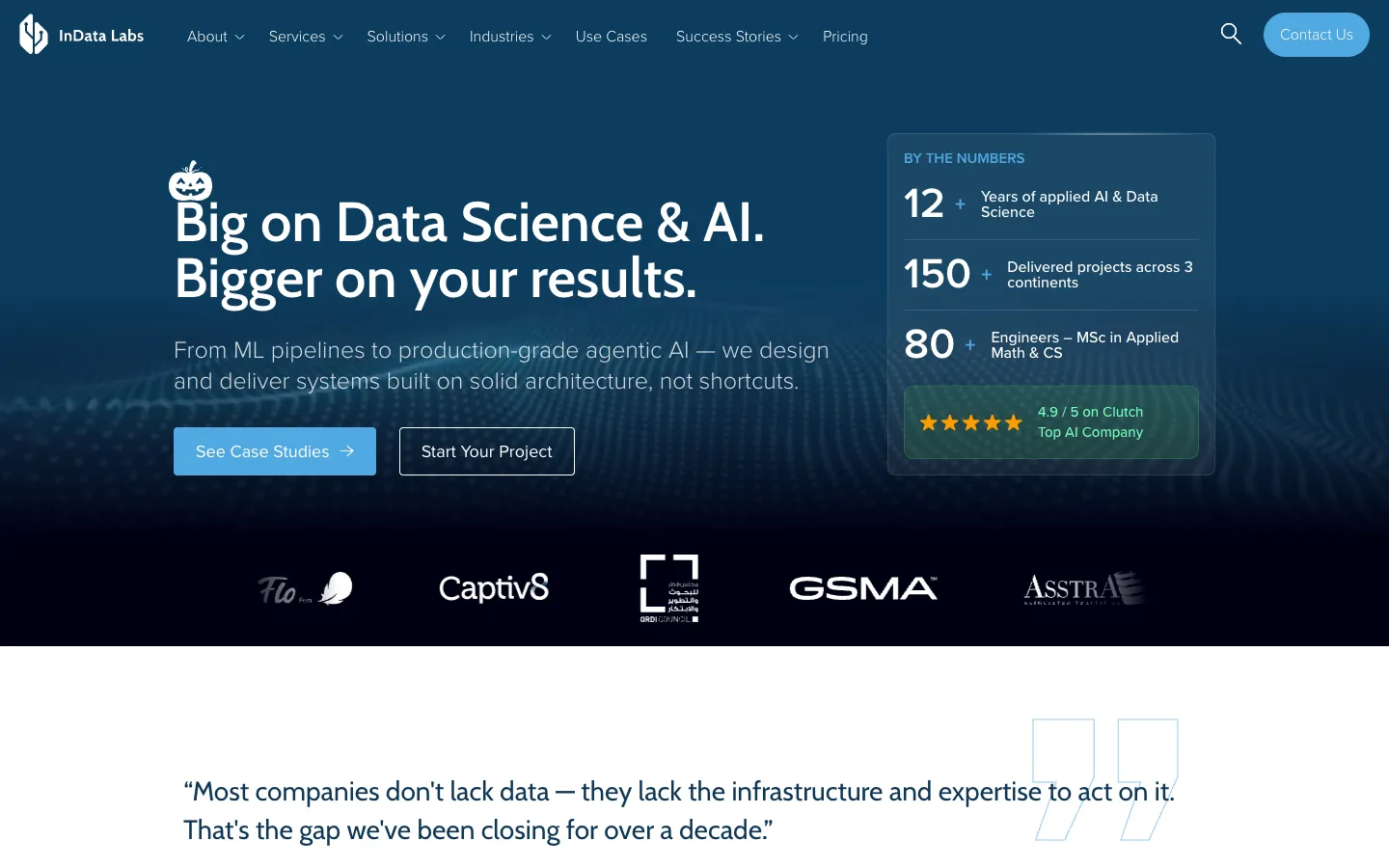
InData Labs started in 2014 and names Cyprus as its headquarters, with offices in the USA and Lithuania. Its services cover machine learning, generative AI and large language models, and computer vision, and it lists marketing, e-commerce, logistics, fintech, and digital health among its industries. It works on time and materials, at a fixed price, or as a dedicated team.
Worth a call if: your project is mostly data science and models, from a forecast to a feature built on a language model.
3. AI Superior
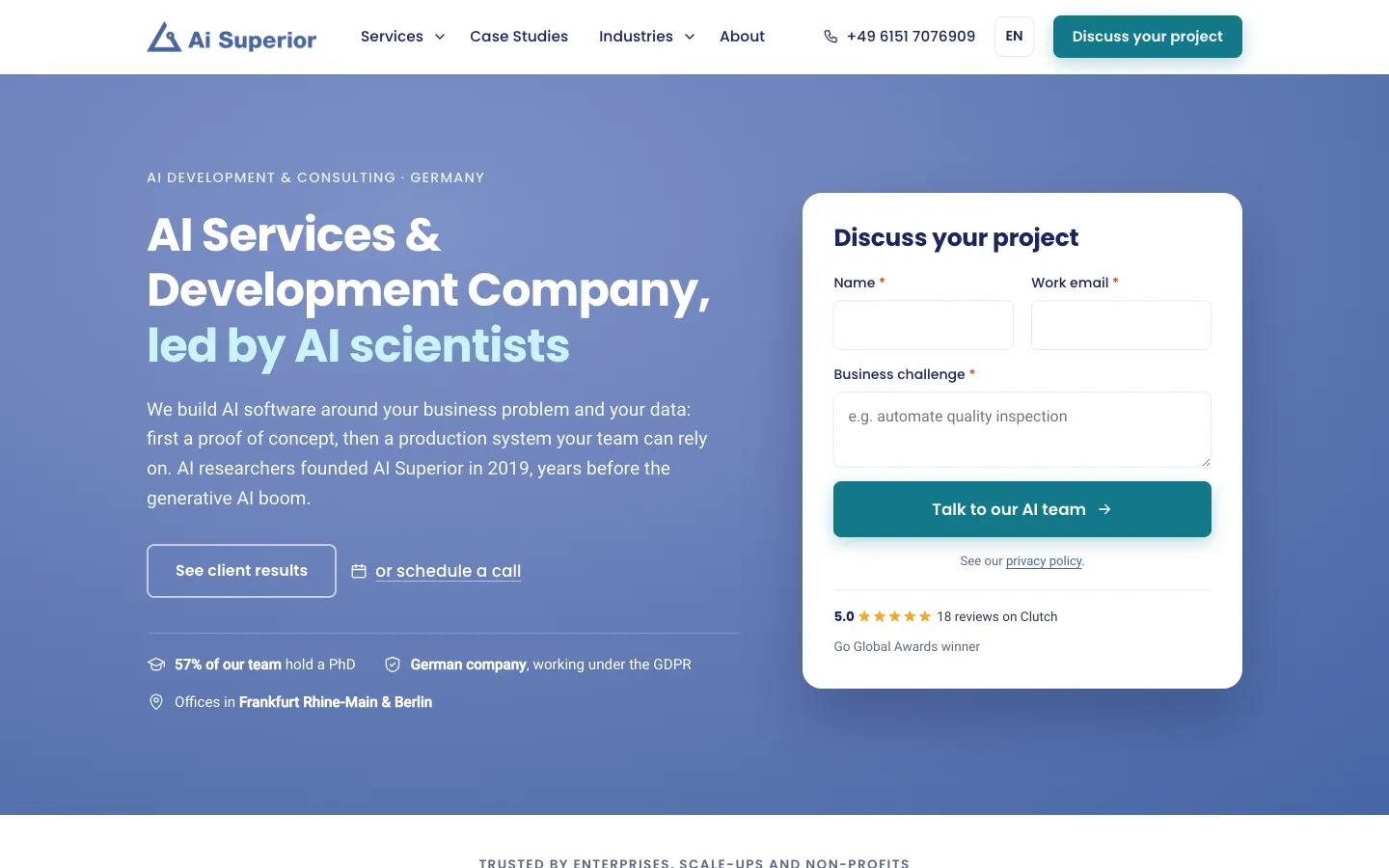
AI Superior is a German company from Darmstadt, founded in 2019 by AI scientists. It builds custom AI software, generative AI and language model systems, computer vision, and predictive analytics. It describes its process as a proof of concept first and a production system after it, and for startups it sells three fixed packages: a proof of concept, an MVP, and a full product.
Worth a call if: you want a research-led team in the EU and, if you are a startup, a fixed package for the first stage.
4. Master of Code Global
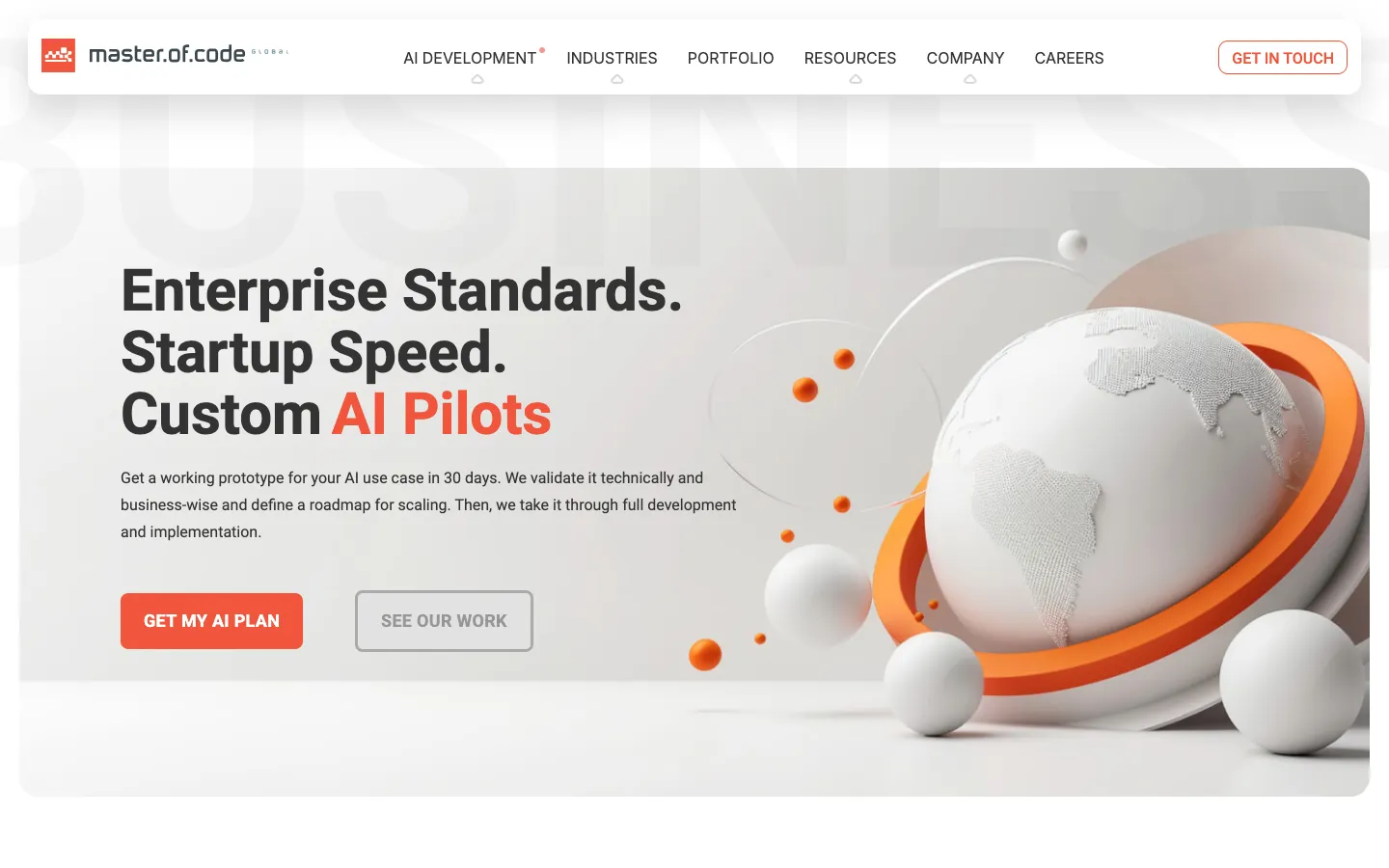
Master of Code Global was founded in 2004 and lists offices in the US, Canada, Poland, and Ukraine. Its AI work covers AI development, AI agents, conversational AI, and generative AI. Its home page offers a working prototype for an AI use case in 30 days, followed by full development. You can hand it the whole project or add its AI engineers to your own team.
Worth a call if: the project is a chatbot or another conversational product, and you want to start with a short pilot.
5. MobiDev
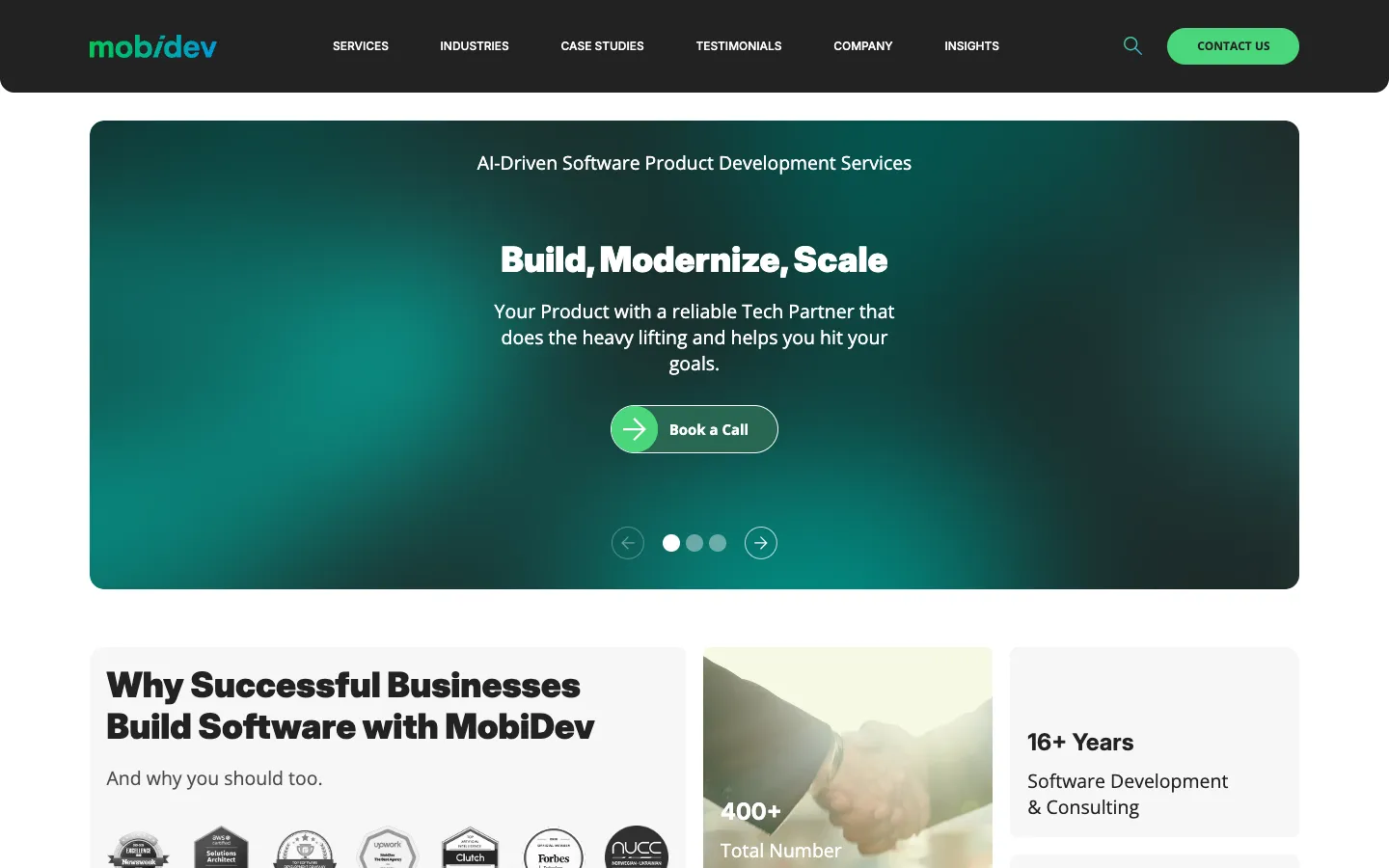
MobiDev has built software since 2009 and lists offices in the US, the UK, Poland, and Ukraine. Its AI services include AI development, AI agents, AI consulting, and machine learning consulting, and its home page also offers to modernize older products. It can add engineers to your team, provide dedicated engineers, or take over whole streams of product development.
Worth a call if: you already have a product and want AI added by a team that can also modernize the rest of it.
6. Azilen
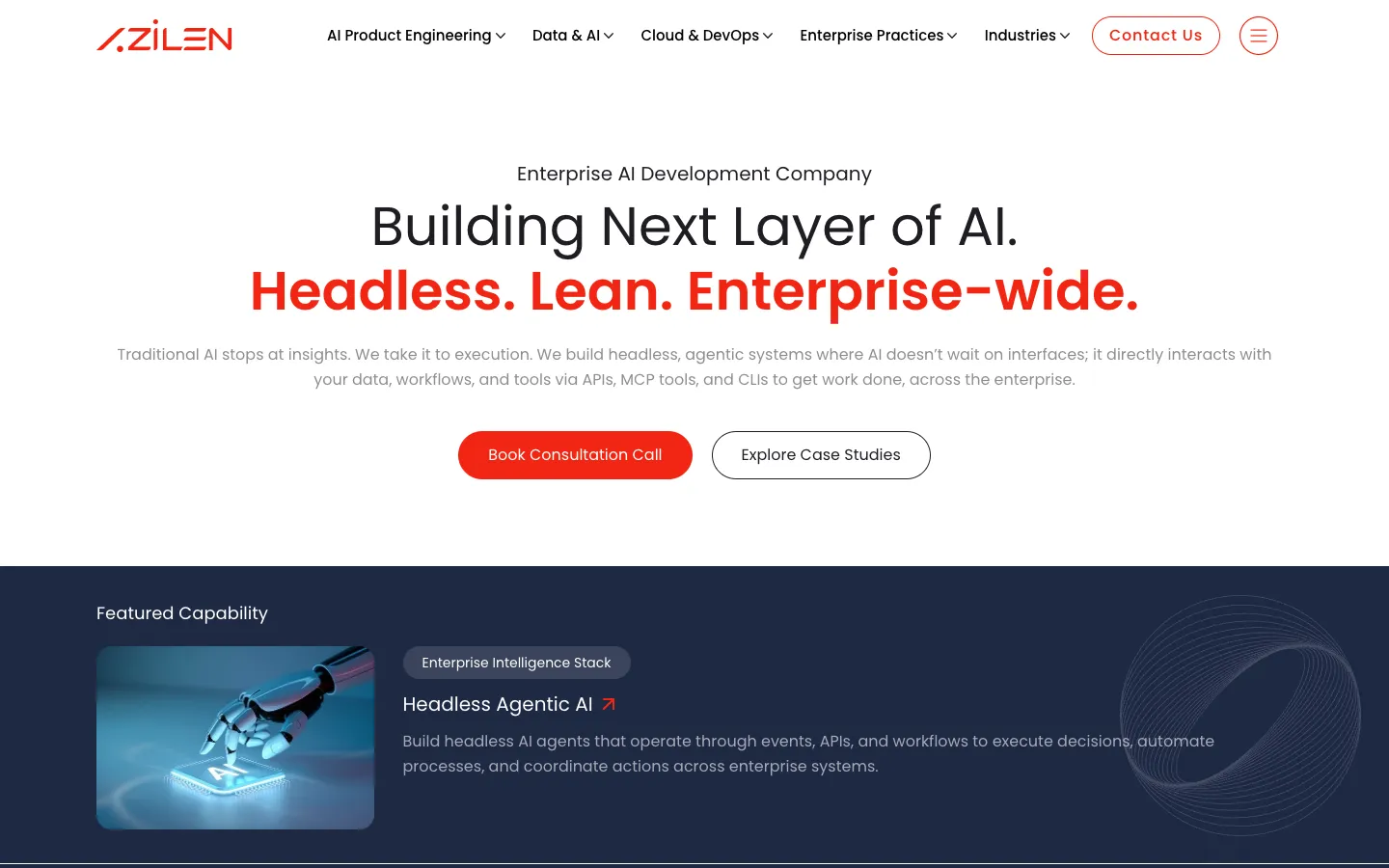
Azilen has worked since 2009 and lists offices in ten cities, from San Francisco and Toronto to London, Pretoria, and Ahmedabad. It calls itself an enterprise AI development company and sells generative AI development, AI agent development, and MLOps, the work of keeping models running in production. Its home page focuses on agents that work through APIs and other tools rather than through screens.
Worth a call if: your company is large and wants AI agents connected to many internal systems.
How to choose an AI development company
The checks that apply to any software vendor still apply here: a technical person on the first call, an estimate with its assumptions in writing, and past clients you can call. Our guide to software outsourcing companies covers those. The five questions below are specific to AI work.
1. Does your task need AI at all?
A good company tells you when a rule, a search filter, or an ordinary form solves the problem for less money than a model. Ask each company which parts of your brief it would build without AI. If we see that custom AI is not needed, we say so and suggest the alternative. When nobody can tell yet whether a model handles the task, an AI proof of concept tests it on your own examples before you pay for the full build.
2. Have they built an AI feature into a complete product?
A demo shows the answers that went well. Ask which AI feature the company built into a whole product rather than a prototype, and who it is for. In a whole product, the model's answers have to fit the screens, the data, and the admin panel around them, and a demo does not show that work.
3. Where will your data go?
Ask which model provider the feature will call, which of your data leaves your systems, and whether the provider may use it to train its models. The answer is in the provider's terms, not in the vendor's sales deck. For example, Anthropic's commercial terms say that “Anthropic may not train models on Customer Content from Services.” Our guide to generative AI integration covers the data and security questions in more depth.
4. How will they test the model's answers?
A model can answer the same question in different ways, so the usual pass-or-fail tests do not cover it. Ask how the team checks answer quality before release and after every change. A useful answer describes a saved set of anonymized or synthetic examples with the expected result, run again whenever the prompt or the model changes. In our own sales tools, every version of a prompt is a file in git, a version control system, and a new version runs on the same saved cases as the old one before it goes live.
5. Who updates the feature when the model changes?
Model providers retire old model versions. OpenAI's deprecations page says it regularly retires older models and, unless safety or compliance concerns require a faster timeline, gives at least six months' notice before it retires a generally available one. Ask who watches those notices after launch, who moves the feature to the new version and tests it again, and whether that work is in the support agreement.
A chatbot that answers from your documents depends on a second model as well. The search index it builds belongs to one embedding model, so changing that model means processing your whole document base again; our guide to AI knowledge management explains why. Ask which embedding model the feature will use, whether the original texts are kept next to the numbers so they can be processed again, and what a full re-index of your documents would cost.
“Treat a new model version like an update to any library you depend on: run your saved examples on it before you switch. A newer model can do better on average and still fail the one case your users rely on most.”
Evgeny Leonov, CTO at Ronas IT
How development companies use AI in their own work, and how we do it
In the Stack Overflow Developer Survey 2025, 84% of respondents said they use or plan to use AI tools in their development process. Yet in the same survey, more developers said they distrust the accuracy of AI tools (46%) than trust it (33%).
The volume of AI output is growing faster than the trust. DX, which sells engineering measurement tools, surveyed developers at more than 400 companies in April-June 2026: on average, 51.9% of their code was AI-authored, meaning generated by AI without major human rewrites, up from 27.4% in the first quarter. DX calls these self-reported estimates, not exact measurements. With half the code written by AI, ask a vendor how its reviews keep up.
Ask a company which steps of its delivery use AI and who approves each result. A clear answer names the step, what the tool does there, and the person who approves the output. Also ask whether the time AI saves shows up in the quote; our guide to choosing a software development company lists the questions to put to every vendor.
Here is our own answer. At Ronas IT, our engineers and designers work with AI agents at every stage of a project, from analysis and design to testing, release, and support. They give the agents their tasks, make the architecture decisions, and accept the result, and whoever runs an agent answers for its output.
What an AI project costs at Ronas IT
Our AI work starts at $3,000, the price of one AI feature, such as a chatbot, in a product you already run.
| Work | When it fits | Starting price | Timeline |
|---|---|---|---|
| Analysis phase (optional): use cases, a feasibility check on your examples, and a written scope | Your scope is not written down yet, or you are not sure a model can handle the task | $1,000 to $2,000 | At least 1 week |
| One AI feature in your product: a chatbot or an assistant, recommendations, an agent, or an MCP server | The product exists, and the model answers questions or acts in your systems | From $3,000 per AI feature | At least 1 week |
| New AI product: a basic MVP built around the model | You start from an idea, and the first release tests it with users | From $5,000 | At least 2 weeks |
| Machine learning: a model trained, evaluated, and connected to your systems | You need predictions from your own historical data | From $15,000 | At least 6 weeks |
Each price already covers design, project management, and testing, including the new screens an AI feature adds to your existing product. A new AI product counts its AI features in the MVP price, together with the backend and admin panel it needs; a first release with more roles and integrations starts from $10,000. The price covers one client platform, such as a web app, and each extra platform adds from 50% of the first. After launch, the model provider bills you for usage, you pay for hosting, and maintenance, if you choose it, starts at $1,000 per month for one app and $2,000 for a whole system. To compare our quote with others line by line, see what AI development costs and how to compare quotes.
What to do next
- Write down the task for the model: what goes in, what answer you expect, and how you will tell a good answer from a bad one. Collect anonymized or synthetic examples of both.
- Pick the companies from the table whose AI work matches your task.
- Send all of them the same brief and ask each one which parts it would build without AI.
- Ask each finalist the five questions above and get the answers in writing before you sign.
- If nobody can say yet whether a model handles your task, start with an analysis phase that tests it.