Outsourcing software development for startups: what to hand over, what to keep, and how to choose a team


In our view, outsourcing software development makes sense for a startup that needs a first version before it can afford to hire an engineering team or knows how to lead one. At Ronas IT, a basic MVP starts at $5,000 and takes at least two weeks, whether it is a web app or a mobile app for iOS and Android. Hand over the build and keep the product decisions, ownership of the code, and someone technical who reviews the vendor's work.
The harder questions come after the decision to outsource: which model fits the stage you are at, what stays with the founders, how to tell a team that will protect your budget from one that will spend it, and when to bring the work in-house. This guide answers them from the vendor side, with two of our client projects as examples.
Key benefits of software outsourcing for startups
An outside team handles hiring and staffing for a release. For a startup with a short runway, which is the number of months the cash will last, that matters more than the hourly rate.
- A full team for one release. A first version needs design, development for the client and the server side, testing, and project management. An outside team fills all of these roles at once.
- No recruiting before the first screen. The time you would spend hiring engineers goes into building and testing the product.
- Costs tied to the scope. When the release ships, the build spending stops. Hosting and maintenance continue, and the next stage can wait for the next funding round instead of running on salaries.
- Founder time back. You keep investors, sales, and user interviews and hand off the daily management of engineers. Product decisions, acceptance of each deliverable, and technical review stay on your side.
When not to start with a full outsourced release
In the situations below, we usually advise against a full outsourced release as the first step.
- You have a technical co-founder with time to hire. Someone who can interview, lead, and review engineers can build a team that stays after the first release.
- The core of the product is an unsolved technical problem. If nobody knows yet whether the key feature can work, run a small proof of concept before an MVP instead of buying a full release.
- Nobody on your side can make product decisions. A vendor can propose what to cut and in what order. It cannot decide what your product is for, and a team waiting for that answer wastes paid time.
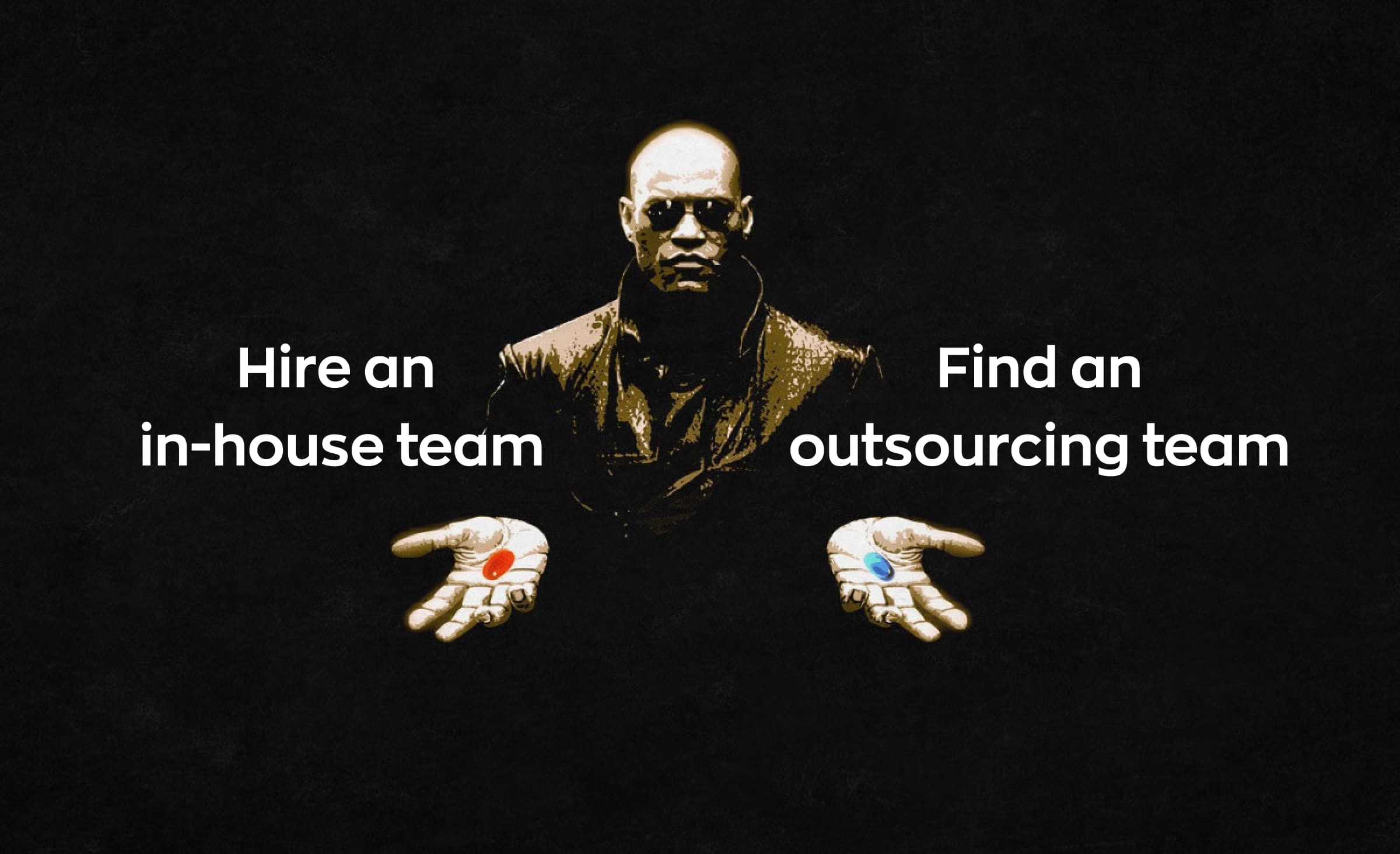
Which outsourcing model fits your stage?
The right model depends on how settled the product is and whether you already have a technical lead, not on the size of the budget.
| Your situation | Model that fits | Starting price at Ronas IT |
|---|---|---|
| An idea and a budget, no product yet | Fixed-scope MVP project | Basic MVP from $5,000, at least 2 weeks |
| A launched product that keeps changing | Dedicated team on a monthly basis | From $8,000 per month: two developers who build with AI agents, plus a part-time project manager |
| Your own tech lead, missing skills | Dedicated team that works inside your process | From $8,000 per month |
Freelancers are one more option, but they move the management to you: you write the tasks, check the work, and connect the pieces. That works for a landing page or a single integration. For a whole first version, it turns a founder into an unpaid project manager.
An MVP development project is the starting point we suggest for an early startup, because it prices one release instead of an open-ended team. If you are still deciding what that release should contain, our step-by-step guide to building an MVP covers scoping before you talk to vendors.
What outsourcing costs at Ronas IT
The basic MVP in the table above covers only the main features, and its price is the same whether the first release is a web app, one cross-platform app for iOS and Android, or one native app. An extended MVP with more features, roles, and integrations starts at $10,000 and needs at least five weeks. Two-sided products with complex business logic, such as marketplaces, start at $20,000 and eight weeks. Products under financial or medical regulation, such as lending or patient records, start at $30,000 and ten weeks because they carry compliance work. Each of these prices already covers design, project management, testing, and the backend the product needs.
A cross-platform app for iOS and Android sits on the same ladder: a basic one starts at $5,000 with its backend included. A web app next to it is a second platform and adds from 50% of the first, so a web MVP with a mobile app starts at $7,500. If the scope is not written down yet, our analysis phase maps the user stories, checks what is technically feasible, and ends with a written scope, budget, and timeline; it costs $1,000-$2,000 and takes at least one week.
To compare with hiring, price the same milestone both ways: a vendor's written quote against the salary, recruiting time and management of every role that milestone needs. After launch, hosting in your own cloud account is an ongoing cost, paid to the cloud provider. Our support for one app with its backend and admin panel starts at $1,000 per month; a system with several client apps, such as web and mobile, from $2,000.


What to outsource and what to keep in-house
Outsource the execution and keep the decisions and the ownership. The team you hire can design, build, test, and release, and it should propose what to cut.
| Area | The outside team | The founders |
|---|---|---|
| Product goal and priorities | Proposes what to cut and in what order | Decide what goes into each release |
| User research | Turns findings into flows and screens | Talk to users and own what they say |
| UI/UX design | Designs the flows together with the developers | Approve the flows before the build |
| Development and testing | Builds, tests, and releases | Accept or return each deliverable |
| Code and infrastructure | Sets up the environments and the repositories | Own the cloud account and hold full access to the repositories |
| Technical direction | Recommends the stack and the architecture | Keep someone who can review that advice |
Ownership is an easy row to leave for later. On our projects, the client owns the cloud account that production runs in, and the code repositories live in the client's organization by default. Keeping them on our side is an exception, and then the contract spells out the transfer. The contract should cover ownership in legal terms. Under US copyright law, a commissioned work counts as a work made for hire, with the client as its author and copyright owner, only if it falls into one of nine listed categories and the parties expressly agree to that in a written agreement signed by all of them, as the U.S. Copyright Office explains. When the client gets the rights through a transfer of copyright ownership instead, the transfer is valid only if it is in writing and signed by the owner of the rights or the owner's authorized agent. Custom software often does not fit those nine categories, so ask for a written clause that assigns the copyright to your company, and have a lawyer read it.
Our guide to the outsourcing contract and the first 90 days goes through the clauses one by one.
How to choose a tech partner as a startup
Choose the team that will protect your budget and fill the gaps in your founding team. The general vendor checks, such as references, reporting, and the first call, are in our overview of software outsourcing companies and how to compare them. Five checks matter more when you are a startup.
1. Will they cut scope with you?
Plan the first release to launch before the money runs out: a feature moved to version two costs less than a missed launch. In its 2026 analysis of 431 VC-backed startups that have shut down since 2023, CB Insights could identify the reasons for failure at 385 of them. Among those 385, “ran out of capital” was at the top of the list, at 70%, but the report called it almost always the final cause of death rather than the root problem. Poor product-market fit, at 43%, was one of the reasons the capital ran out. Ask each candidate which of your features they would move to a later version and why. A team that agrees to everything is pricing more than your launch needs. A fixed demo or launch date works the same way: fit the scope to the date.
In 2018, the team behind OddsCrowd, a web app for a community of sports bettors, came to us with a hard deadline: the app had to be ready in four months. After the design and the first iteration, we and the client moved two features out of the first version, shareable statistics images for social media and extra detail in user ratings, because they took a lot of build time. The first version shipped in 14 weeks, within the deadline.
“On a deadline, the useful question is which parts can wait until after the launch. A good answer names a first cut before you sign, and a second look after the first iteration, when the estimate is based on real work.”
Alexander Storozhevsky, Lead developer at Ronas IT
2. Can they help you define the product as well as build it?
If you know your market but have never built software for it, ask how the team would turn your idea into screens and logic before any code, and what they would need from you to do it.
The client behind Buke, a dating app built around anonymity, had no experience in creating apps of this kind. Our team worked out the matching system, the profile logic, and the favorites page with them and mapped the app in a mind map. The project started as an MVP and grew into a full mobile app with a web version and a landing page, and within three months of launch the app had 4,000 active users.
3. Is someone technical on your side?
If nobody on the founding team can read an architecture decision, add that person before you sign: a part-time advisor, a fractional CTO, or a technical lead of your own, as long as they work for you.
“A founder without a technical background is trusting us twice: once to build the product and once to say it is built well. I would rather they did not have to. Even a few hours a month of review by an engineer who works for the founder helps, because our choices then have to make sense to someone other than us.”
Evgeny Leonov, CTO at Ronas IT
4. Is there a plan for handing the product to your own team?
Ask how the vendor would hand the product over to engineers you hire later, before you need it. A clear answer names the documents, the length of the handover, and who trains your people. If the only answer is “you will not need to”, you are buying a dependency.
5. How do they use AI agents, and who answers for the result?
For a startup, AI in delivery matters for two reasons: runway and risk. Ask four things: which engineer accepts the code an agent writes and answers for it, whether that code goes through the same tests and review as code a person writes, which AI services read your code and documents and under whose accounts, and whether the speed shows up in the quote. A team that credits AI for its pace but prices the release like manual work is keeping the saving.
With us, the person who runs an agent owns what it delivers, and model access goes through company accounts rather than personal subscriptions.
Risks of outsourcing for startups, and how to reduce them
Each risk below has a cheap safeguard to agree on before the first sprint.
- Scope growth uses up the runway. Fix the scope of the first release and agree in writing how a new request gets estimated and approved.
- Lock-in to the vendor. Run production in your own cloud account, keep the repositories in your organization, and write the transfer of code and access into the contract.
- Quality you cannot judge. Ask for something you can open after every sprint, and have your technical advisor review the code at each milestone.
- Slow decisions on your side. Name one person who can approve scope and designs, and agree how fast both sides reply to questions.
On our projects a sprint is usually one to three weeks long and closes with a result the client can open: a fresh build on the dev server, a screen to test, or updated mockups. Whatever the vendor, that is the rhythm to ask for, because a status report is easier to produce than work you can check yourself.
Moving from an outsourced team to your own
Bring development in-house when the product has steady demand, the roadmap runs a year or more ahead, and you can afford a technical lead who will own it. Before that point, an in-house team is a fixed cost attached to a product that may still change direction.
Hire the technical lead first, while the outside team is still working, so the lead learns the codebase from the people who wrote it. Our structured handover then takes two to four weeks and covers deployment runbooks and knowledge transfer. The outside team can stay afterwards: a dedicated team covers peaks and skills you do not need full-time.
What to do next
- Write down what your first release has to prove, in one sentence, and list the features in the order you would cut them.
- Pick the model for your stage: a fixed-scope MVP if you have no product yet, a monthly team if the product is live and changing.
- If nobody on the founding team is technical, add a reviewer who works for you before you sign.
- Open the cloud account in your company's name and get full repository access.
- Ask each candidate which features they would move to a later version, and how they would hand the product to your future team.
- Plan the move in-house for when demand is steady, and hire the technical lead before the handover.
The aim of an outsourced first version is a product that works and that you own, understand, and can grow with whichever team comes next.
First published 2023-07-18 by Evgeny Leonov, CTO at Ronas IT. Rewritten by Roman Surikov.
Frequently Asked Questions (FAQs)
Should a startup outsource software development?
How do you outsource software development as a startup?
How much does it cost to outsource MVP development?
Is it cheaper to outsource or hire in-house for a startup?
Should a startup outsource to a local or an offshore team?
What should a startup keep in-house when outsourcing?
Do I need a CTO before I outsource development?
Can an outsourced team build an MVP in a month?
When should a startup move development in-house?
Who owns the code when a startup outsources development?
Related posts








Related Services
MVP Development Services
Need to launch your startup quickly? Ronas IT offers urgent MVP development services, allowing you to get a fully-functional app in 4 to 12 weeks, depending on scope. Ideal for testing business ideas, presenting to investors, or entering the market swiftly. Benefit from our extensive experience and accelerated development process.
iOS App Development Services
Choose native iOS when the product leans on Apple hardware, the newest OS features, or the wider Apple ecosystem. Ronas IT builds on Swift and SwiftUI and covers UI/UX design, development, the App Store release, and ongoing support, with single-purpose apps shipping in 8-12 weeks.
Dedicated Development Teams
Ronas IT’s dedicated development teams consist of skilled specialists — including developers, designers, and project managers — who focus exclusively on your product. Get fast onboarding, flexible team scaling, transparent workflows, and ongoing support. Skip hiring hassles and keep your attention on business growth while we deliver quality results on time and within budget.