
A list of famous apps does not tell you whether React Native app development suits your product. What helps is seeing examples grouped by product type: marketplaces, dating and community apps, real estate search, fitness and health, and apps built around a live feed. The framework behaves differently in each one. Below is a well-known app for each type, where one exists, and a project we built ourselves, with the cost, the timeline, and the parts that still needed native code.
React Native app examples at a glance
Each row pairs a public example with one of our own projects, so you can find the product type closest to yours and read the section that matters.
| Product type | Well-known example | Our project | What usually needs native work |
|---|---|---|---|
| Marketplace and rental | Airbnb (adopted, then moved back to native) | A UAE plant marketplace and Lainappi | Map rendering and identity checks |
| Dating and community | Discord | Buke | Push notifications and store payments |
| Real estate search | No widely documented public example | A US property search platform | Map SDK and image-heavy lists |
| Fitness and health | No widely documented public example | A cross-platform fitness platform | Step counters and health data permissions |
| Real-time data feeds | Bloomberg | OddsCrowd | Background refresh and deep linking |
What the best-known React Native apps prove
Famous names answer one question and leave the other open. Meta created React Native and still ships it inside Facebook, and Shopify reported in January 2025 that it had migrated all of its apps to the framework, with screen loads under 500 ms at the 75th percentile and more than 99.9% crash-free sessions. Apps of that size prove React Native can carry a serious product for years. They do not tell you whether it fits yours, and Airbnb makes the same point from the other side: it moved back to native in 2018 after running React Native next to two large native codebases. The public examples in the table above, and the rest of the roster with the source behind each name, are in our list of well-known apps built with React Native.



React Native app examples from our own projects
We use React Native on most of our mobile projects, so the examples below come with the details a public app list rarely has: what the app had to do, what it cost, how long it took, and which parts we had to handle natively.
Marketplace and rental apps
Marketplaces are the product type React Native handles most comfortably, because the hard parts sit in the backend rather than on the device. For a plant marketplace built for the UAE market, we shipped one React Native app serving both buyers and sellers, with Laravel and PostgreSQL behind it. The demanding features were integrations rather than UI: Persona for seller license checks, an OpenAI assistant that answers plant questions, ChatKitty for chat between buyers and sellers, and Google AdMob for monetization. An admin panel handles user, ad, and license management. Both the interface and its light and dark themes had to flip cleanly between left-aligned English and right-aligned Arabic, which shaped the layout work from the start.
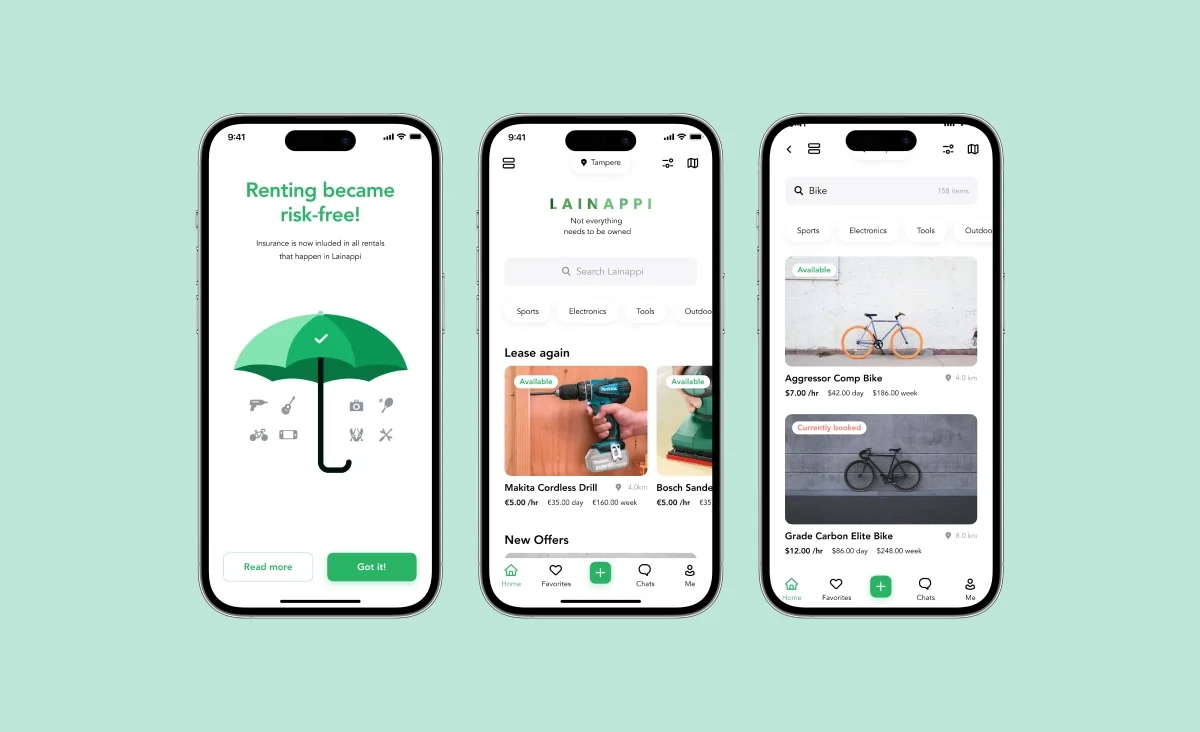
Lainappi, a Finnish app for renting items out, shows the same pattern in a peer-to-peer setting. Its client wanted to test the idea on the market quickly and without extra cost, so a single codebase for iOS and Android was the practical answer. Stripe Connect verifies item owners and moves the money, while react-native-maps and expo-location gave us map search with filters on both platforms at once. The app recorded 5,685 launches.
Dating and community apps
Buke is a dating app built around anonymity: signing up takes only an email and a nickname, and matching runs on a questionnaire instead of photos. The React Native app took 5 months and cost $60,000 or more, built by a team of two React Native developers plus a tech lead, a backend developer, a designer, a DevOps engineer, and a manager. Within three months of launch it had 4,000 active users. A Laravel Nova admin panel handles moderation and user reports.
The schedule was then set by something no framework prevents. The App Store took six months to accept the app, so we built a web version in React to keep iOS users reachable while we waited; that fallback took another 3 months and cost $30,000 or more on top of the mobile build. If your category is one that app stores treat with suspicion, plan a web fallback into the budget rather than discovering it late.
Real estate search apps
Property search is the hardest of these types, because it asks for high-resolution photography, live chat, and fast filtering in the same session. On our cross-platform property search app for the US market, the MVP took 5 months and cost $75,000 or more, with a team of two React Native developers, a backend developer, a designer, a DevOps engineer, and a project manager. The stack leaned on Expo and EAS for builds, Redux Toolkit for state, the Google Maps SDK for browsing by neighborhood, Pusher for real-time chat between buyers and agents, and Stripe Identity for agent verification. Keeping imagery, chat, and search fast at the same time took deliberate optimization rather than default settings.
Fitness and health apps
Fitness apps read sensor data and sync it across devices, which means touching platform health permissions and, in the EU, GDPR rules for that data. Our cross-platform fitness platform tracks steps, calories, heart rate, and nutrition, adds AI suggestions that adjust workout length or propose a rest day, and includes a web version and a Laravel Nova admin panel. It launched after 8 months of development and cost $90,000 or more. The mobile app and the web app shared design decisions, which is where cross-platform work pays off twice.
Real-time data apps
OddsCrowd is a React Native app for sports bettors, where odds and live scores refresh continuously and a link has to open the right screen whether or not the app is installed. The web platform came first, and for the mobile apps the client came to us 10 weeks before the Super Bowl and needed something scalable fast, so the timeline drove more early decisions than the feature list did. Frequent background refresh and deep linking are the native-adjacent parts of this product type. If your app is built around a live feed and a hard launch date, budget for that plumbing rather than assuming the UI layer is the work.
Where React Native still needs native code
Every project above needed some native work. Being specific about where it appears is more useful than claiming the framework covers everything.
- Long media-heavy lists. Feeds of photos and cards are the most common performance complaint. Modern list libraries and the New Architecture solve it, but only if the list is built for virtualization from the start.
- Device sensors and health data. Step counts, background location, and health permissions differ per platform, so this code gets written twice even inside a shared codebase.
- Camera-first products. If the camera is the product rather than a feature, expect a native camera module and native image handling.
- SDKs without maintained bindings. Payment, advertising, or verification providers sometimes ship no React Native support, and then someone writes the bridge.
- Text direction and locale layout. Supporting right-to-left languages such as Arabic takes real research, as it did on both Buke and the UAE marketplace, not a configuration flag.
“We pick React Native when most of the product is screens, lists, and API calls, which describes the majority of apps people ask us to build. When the core of the product is the device itself, a camera pipeline or a graphics engine, we say so early and scope native work into the plan. The framework is a default, not a religion, and the honest answer usually comes from one question: is the hardest part of this app on the phone or on the server?”
Evgeny Leonov, CTO at Ronas IT
How to tell whether React Native fits your app
Run your idea through four checks. If the first three are yes and the fourth is short, React Native is likely the cheaper route to both stores.
- Do you need both platforms from day one? If iOS and Android have to launch together, one codebase lets one team share most implementation work, while each platform still gets its own tested binary and store submission.
- Is the product mostly screens and data? Listings, profiles, chat, dashboards, and checkout flows are what the framework does best.
- Will you keep iterating after launch? Shared code lets the team implement most changes once, so both platforms move together, which matters more than any saving on launch day.
- How long is your native list? Write down the features that need platform-specific code. A short list is normal. A long one means you are paying for two codebases and a bridge between them.
On price, a cross-platform app built with React Native for iOS and Android starts at $20,000 with a timeline from 4 weeks. Larger builds scale as the examples above show. Current starting points for every option are on our pricing page, and what affects React Native app cost at each stage breaks down where the hours go. If chat is central to your product, our guide to building a chat app with React Native covers that flow in detail, and for retail there is a walkthrough of React Native e-commerce app development.
What to do next
Take the product type closest to yours from the table above and copy its shape. If you are building a marketplace, plan for identity checks and payouts through a provider instead of writing them yourself. If you are building around a live feed, budget for background refresh and deep linking. If your category is sensitive to store review, add a web fallback to the plan the way we did on Buke. Then list every feature that touches the device itself and share that list with a React Native development team. The length of that list, not the framework, decides how much a cross-platform build saves you.
Frequently Asked Questions (FAQs)
Which product types fit React Native best?
Is React Native still a safe choice in 2026?
What types of apps should not be built with React Native?
Why did Airbnb stop using React Native?
How much does a React Native app cost?
How long does it take to build a React Native app?
Can a React Native app use the camera, maps, and payments?
Is React Native a good choice for an MVP?
Related posts





Related Services
React Native App Development Services
Save time and costs with Ronas IT's React Native app development, allowing cross-platform capabilities for iOS and Android. Our team has built 20+ React Native apps since 2020, ensuring rapid development, flexible maintenance, and cost-effective solutions.
MVP Development Services
Need to launch your startup quickly? Ronas IT offers urgent MVP development services, allowing you to get a fully-functional app in 4 to 12 weeks, depending on scope. Ideal for testing business ideas, presenting to investors, or entering the market swiftly. Benefit from our extensive experience and accelerated development process.
Cross-platform App Development
Ship to iOS and Android from one React Native codebase instead of funding two native teams. Ronas IT handles UI/UX design, development, and the releases to Google Play and the App Store, delivering high-performance, secure apps within 2 to 4 months.