
Healthcare apps handle sensitive details like names, addresses, test results, and medical histories. If this data leaks, users can suffer from fraud or even face discrimination. The United States and the United Kingdom have different sets of rules like HIPAA compliance and GDPR, and entrepreneurs need to understand the differences. In this article, we'll look at the main differences between US and UK healthcare laws and share how you can develop medical apps that stay compliant in each region.
Healthcare laws in the USA
Healthcare laws in the USA focus on protecting patient rights and health information. The key regulation is the Health Insurance Portability and Accountability Act (HIPAA), which guides how healthcare entities use, store, and share protected health information. HIPAA compliance is a legal requirement for every healthcare provider in the United States. Together, these organizations are called HIPAA covered entities. This compliance includes a set of rules, let's look at the key ones.
Privacy Rule
The HIPAA Privacy Rule sets the standards for how healthcare entities handle patient information. It requires them to keep patient care confidential and prevent unauthorized access. HIPAA rules make sure health information remains secure, whether it is stored in paper or digital form. Protected health information covers any patient data that can identify a person. This includes information such as diagnoses, test results, and demographic details.
Security Rule
With the rise of electronic health records, the HIPAA Security Rule defines how organizations must protect electronic protected health information. This rule promotes strong technical, physical, and administrative security measures to stop data breaches or tampering. Regular risk assessments help organizations check for threats and make improvements as needed. Failure to meet these HIPAA requirements can lead to penalties and fines.
Breach Notification Rule
The Breach Notification Rule is a key element of HIPAA regulations. It requires healthcare organizations and business associates to quickly notify affected individuals and government authorities when a data breach exposes protected health information. The rule makes it clear that any disclosure of health information must be reported.
Omnibus Rule
The Omnibus Rule expands the reach of HIPAA regulations beyond just healthcare providers to include business associates. Any company or contractor handling patient data must now meet strict privacy rule standards. The rule also enhances patients' rights over their health care records and raises penalties for not following the law.
Enforcement Rule
The HIPAA Enforcement Rule outlines how the government monitors and investigates compliance. It establishes penalties for violations and holds healthcare entities and business associates accountable for the safety of health information.
The HITECH Act
The Health Information Technology for Economic and Clinical Health (HITECH) Act works with HIPAA to further improve health data protection in the USA. The HITECH Act encourages the shift to electronic health records, strengthens data security, and increases penalties for HIPAA violations. Other laws, such as those set by the Department of Health and Human Services (HHS), also focus on protecting the privacy of health data.
HIPAA compliance in practice
HIPAA compliance means following all the necessary steps and precautions outlined in the rules. This applies to both large hospitals and small clinics, as well as any healthcare business or associate that works with health information. A healthcare provider must inform patients about rights concerning their healthcare data, give them access to their medical records, and report any unauthorized disclosures. Business associates, such as billing services and IT vendors, must also meet HIPAA regulations when handling patient information.



Why compliance matters
Staying HIPAA compliant builds patient trust and keeps organizations in line with the rules. Compliance with hipaa requirements supports public health and civil rights protections. A HIPAA violation can result in fines from $100 to $50,000 per violation, up to $1.5 million annually, and may also bring criminal charges. This drives healthcare entities to protect the security and privacy of protected health information. For business stakeholders, understanding these regulations is key to operating any medical information service in the United States.
Healthcare laws in the USA have a strong focus on the privacy and security of patient information. HIPAA compliance protects both patient data and the reputation of healthcare organizations.
Healthcare laws in the UK
Healthcare laws in the UK are designed to protect the privacy and accuracy of health information while supporting patient rights. Every healthcare organisation must follow strict rules to protect patient information and ensure transparency in their operations. These laws apply to organizations within both the public National Health Service (NHS) and private healthcare organizations.
Key regulations protecting health data
The main regulations that shape healthcare laws in the UK are the GDPR (General Data Protection Regulation) and the Data Protection Act. Both aim to secure personal health information and other sensitive data handled by healthcare organizations. UK GDPR compliance is mandatory for any healthcare organization processing health data. These rules apply to electronic and paper medical records, ensuring robust protection for patient data.
Risk assessment
A regular risk assessment helps organisations identify vulnerabilities in their systems and processes. By understanding potential risks, healthcare organizations can take reliable steps to avoid data loss or misuse. This active approach supports not just GDPR compliance but also builds trust with patients.
NHS data sharing
NHS Digital oversees healthcare data governance in the UK, setting standards to protect health information and patient care. The Data Security and Protection Toolkit (DSPT) helps healthcare organisations assess and demonstrate gdpr compliance. NHS Digital enforces the Common Law Duty of Confidentiality, requiring healthcare professionals and healthcare organizations to safeguard health information and only share it when necessary.
Regulators of health services in the UK
The Care Quality Commission (CQC) regulates the quality and safety of healthcare services, including the use of IT systems and the management of medical records. Their oversight ensures healthcare organisations deliver safe patient care and protect health data. The Medicines and Healthcare products Regulatory Agency (MHRA) regulates medical devices and software as a medical device (SaMD), ensuring these meet standards for safety and health information security. The Information Commissioner's Office (ICO) acts as the data protection authority, enforcing GDPR. Fines for healthcare data breaches can be significant — often much higher than HIPAA penalties.
In short, healthcare laws in the United Kingdom require every healthcare organization to protect health information, following the standards set by the GDPR and Data Protection Act. Performing regular risk assessment, securing healthcare data, and ensuring continuous staff awareness helps organisations meet compliance.
Difference between the laws
Understanding the difference between HIPAA vs UK healthcare laws is vital for organizations working with health information on a global scale. While both regions value privacy and data protection, the focus and approaches are different.
HIPAA compliance in the US focuses on healthcare providers, business associates, and covered entities, managing protected health information through the privacy rule and clear security requirements. The law covers individually identifiable health information used by medical devices in health care systems. In the UK, GDPR compliance and the Data Protection Act regulate the handling of health data for all organizations, not just healthcare ones, with an emphasis on consent, transparency, and expanded patient rights.
However, the scope is wider under UK law, and requirements go beyond just healthcare data. Here is a detailed comparison of key points:
| Topic | USA | UK |
|---|---|---|
| Core law | HIPAA | GDPR, Data protection act |
| Scope | Health care providers, health insurance, business associates, medical device | All organisations processing patient information, including healthcare organisations |
| Patient rights | Access, correction, restricted sharing of protected health information | Access, correction, erasure, broader rights over patient data |
| Breach notification | Mandatory for certain violations | Mandatory for many types of data breaches |
| Consent | Required for many uses/disclosures of health information | Strong emphasis on informed consent |
| Cross-border data | Permitted with safeguards | Permitted if adequate protections are in place |
| Regulator | Department of Health & Human Services (HHS) | Information Commissioner's Office (ICO) |
| Medical device | Covered if handling health data | Covered if handling patient data |
| Penalties | Fines from $100 to $50,000 per violation (up to $1.5 million/year); criminal penalties possible | Fines up to £17.5 million or 4% of annual global turnover, whichever is higher; significant reputational and legal consequences |
How to build healthcare apps in compliance with the laws
Building medical apps that follow both US and UK healthcare laws requires a careful approach to data protection, privacy, and secure development.
Practical steps for building compliant apps
The development process should begin with a thorough review of what health information your app will collect, how you will store and process sensitive data, and any potential exposure points for protected health information. This helps you prevent unauthorized disclosure and select the safest technologies when developing healthcare software.
Applying best practices throughout the development lifecycle can help your application be HIPAA and GDPR compliant:
- Encrypt healthcare data at rest and in transit — use strong encryption for all medical records.
- Enforce strict access controls — allow only authorized healthcare organizations to view or modify protected health information. Enable activity auditing to track changes and access to patient data.
- Use multi-factor authentication — confirm that only verified users can access health insurance features or patient records.
- Obtain user consent and manage privacy settings — for GDPR compliance, prompt users for consent before collecting or sharing their personal health information. If minors are involved, implement parental consent flows according to the data protection act.
- Practice data minimization — collect only the healthcare data needed for patient care, diagnostics, or analytics, avoiding unnecessary exposure of protected data.
How Ronas IT can help
At Ronas IT, we have experience in building software in compliance with diverse regulations, including HIPAA compliance, GDPR compliance, and others. If you want to create healthcare software and need a reliable development partner, we're ready to help with analytics, UI/UX design, web and mobile development, and ongoing maintenance. Here are a few examples of our projects related to these regulations:
Web platform for analyzing lab test results
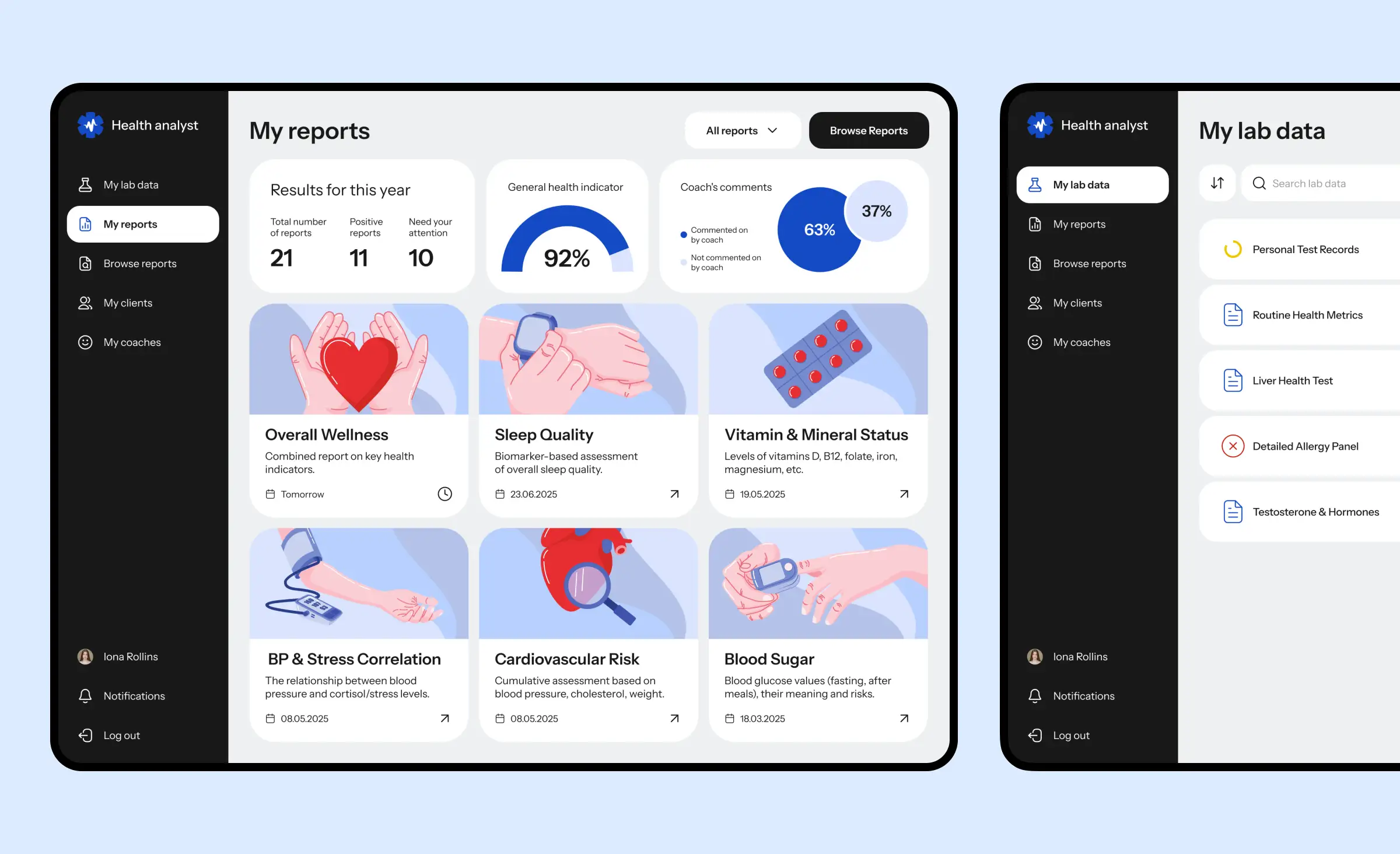
We developed a US-based web platform that allows patients to upload lab test results, store healthcare data securely, and review personalized reports. Patients can connect with healthcare professionals for advice, and healthcare businesses use the app for client data management. Because the platform handles both protected health information, we embedded the United States compliance measures from day one. These compliance steps included:
- Two-factor authentication to secure healthcare provider and user accounts
- Data encryption at all stages for patient data
- Automated logout and activity alerts for enhanced security
- Detailed audit trails for tracking access
- Secure cloud storage and automated database backups
GDPR-compliant EdTech platform

We also created a GDPR-compliant platform for a European education company, supporting both students and teachers with online classes. While not a healthcare app, the platform still needed to protect sensitive data to meet stringent GDPR standards. This is how we ensured compliance:
- Robust authentication for all user types
- Parental consent flows and audit logs to comply with the data protection act, especially when working with minors
- Data storage and processing restricted to the EU for privacy
- Access controls and encryption to limit exposure of all user information
This edtech platform helps users trust that their data and class information are always secure and treated lawfully.
How we ensure compliance
For every project, we apply best practices for encrypting data, controlling access, and monitoring for security events. We build every healthcare app on secure cloud platforms like Amazon or Google, which meet compliance standards. Our CI/CD tools, GitLab and ArgoCD, follow the same security benchmarks. Laravel, our main backend framework, protects against common threats such as DDoS, SQL injection, and CSRF.
We use Infrastructure as Code, least privilege access, company VPNs, and trusted authentication to guard sensitive data. To ensure extra protection, we automate backups, store keys securely, and validate inputs while covering critical modules with automated tests.
If you are interested in building secure, regulatory-compliant solutions handling healthcare data, we can deliver the expertise and partnership you need. Just contact us and we will arrange a meeting to discuss your project and how we can help you.
Conclusion
Healthcare apps must follow complex rules to protect sensitive information and build user trust. Understanding the differences between US and UK laws is essential, as requirements for HIPAA compliance in the United States focus on every HIPAA covered entity and affect how health plans and healthcare providers handle patient data. The UK places strong emphasis on data protection and patient rights as well. If you plan to create or expand a healthcare app, working with experts who know these laws is critical to avoid costly mistakes and penalties. By making privacy, security, and transparency a priority in your app development, you can confidently serve users in both markets and ensure your solutions meet all legal obligations for health plan and patient data management.
Related posts








Related Services

Development
React Native App Development Services

Development
MVP Development Services

Development